25 Studio Apartment Ideas That Make Every Square Foot Work Harder
A studio apartment has to do a lot with very little space. The same room may need to function as a bedroom, living room, dining area, home office, dressing area, and storage zone, often without a single interior wall to separate them.
The best studio apartment ideas do not simply make furniture smaller. They give each part of the room a clear job, preserve traffic flow, use vertical space intelligently, and make furniture work harder.
The ideas below are organized around the problems they solve, from creating a sleeping area and adding storage to making a 500-square-foot studio feel organized and giving a tiny rental more personality.
At-a-Glance: The Best Studio Apartment Ideas
| If you want… | Start with… |
| Maximum floor space | Murphy bed or lofted bed |
| A bedroom-like sleeping zone | Bookcase, curtain, or partial divider |
| A renter-friendly solution | Curtains, rugs, or furniture orientation |
| More storage | Floor-to-ceiling shelving |
| A work area | Wall-mounted or fold-down desk |
| A cozy look | Rug-defined zones, layered lighting, and textiles |
| Modern style | Low-profile furniture and a restrained palette |
| Boho style | Rugs, natural materials, plants, and layered textiles |
| Luxury style | Fewer, better-proportioned statement pieces |
| A tiny or micro studio | Multifunctional furniture and vertical storage |
The guiding principle throughout this list is simple: choose ideas according to what they give back to the room and what they require in return. A curtain may provide flexible separation but little sound privacy. A bookcase adds storage and visual separation but takes up floor depth. A Murphy bed can recover valuable daytime floor space but requires more planning than an ordinary bed.
1. Zone the Studio With Furniture
Best For: Creating distinct functional zones without building walls.
Furniture placement can act as architecture in an open-plan studio. Positioning a sofa with its back toward the bed, placing a console behind the sofa, or arranging two pieces back-to-back can create a visual boundary between the living area and sleeping area.
The trick is to create separation without interrupting traffic flow. You should still be able to walk naturally between the entrance, bathroom, kitchen, bed, and living area.
Key Specs
- Use furniture orientation as the primary divider.
- Keep the main walking path open.
- Consider the swing of doors and access to storage.
- Use a console or narrow table behind a sofa when additional separation is useful.
- Keep large furniture from creating a bottleneck.
Pros
- No construction required
- Flexible and easy to rearrange
- Works with almost any decorating style
- Creates functional zones immediately
Cons
- Provides little actual privacy
- Can consume valuable floor space
- Poor placement can make circulation awkward
Quick Verdict: This is one of the simplest forms of apartment zoning because it changes how the room functions without adding another physical structure. It works particularly well when the studio already has enough floor area for a sofa, bed, and narrow supporting furniture.
Style Fit: Modern, minimalist, vintage, boho, rustic.
2. Put the Bed in Its Own Visual Zone
Best For: Anyone who wants the sleeping area to feel intentional without constructing a separate bedroom.
A studio feels more organized when the bed looks like part of a defined sleeping area rather than furniture dropped into the middle of the room. Use a rug, headboard, pendant light, curtain, artwork, or nearby furniture to establish a visual boundary.
The goal is not necessarily complete privacy. It is to give the sleeping area its own identity.
Key Specs
- Use an area rug to anchor the bed.
- Add a distinctive headboard or wall treatment.
- Use focused bedside lighting.
- Keep bedding within a controlled color palette.
- Leave enough room to make the bed comfortably.
Pros
- Simple visual separation
- Makes the room feel more intentional
- Works in very small studios
- Does not require permanent construction
Cons
- Provides little physical privacy
- Too many decorative elements can increase visual clutter
- An oversized bed can overwhelm the zone
Quick Verdict: When a separate bedroom is impossible, a clearly designed bed nook is often enough to make the studio feel like it has multiple rooms.
Style Fit: Cozy, minimalist, boho, modern, vintage.
3. Use a Bookcase as a Room Divider
Best For: Renters who need both storage and visual separation.
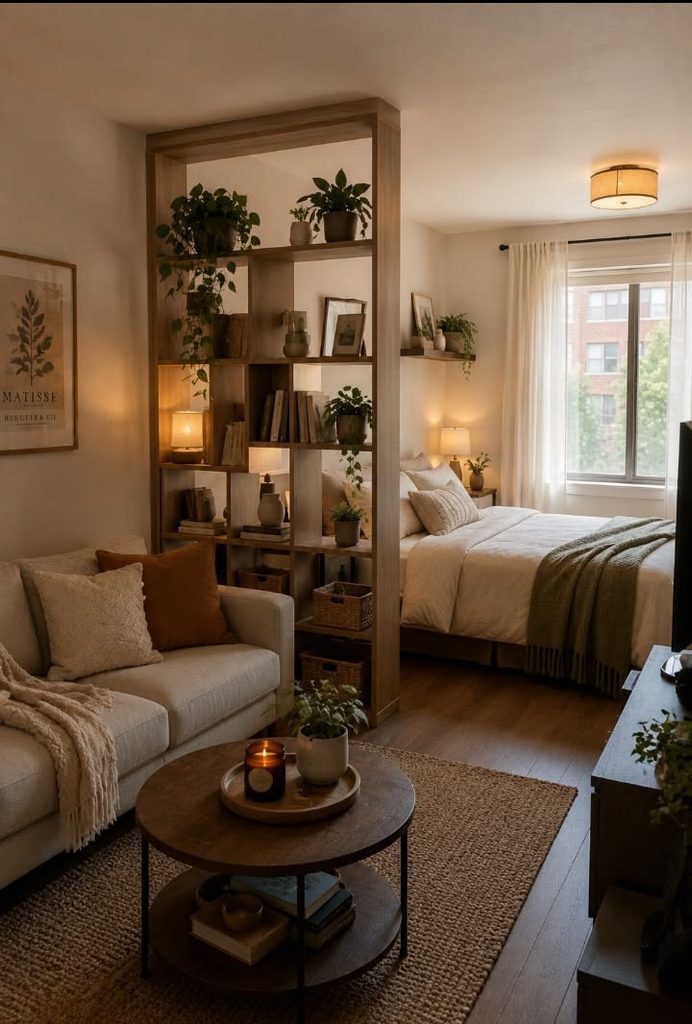
An open bookcase is one of the most useful studio room dividers because it performs two jobs at once. It establishes a boundary while providing vertical storage for books, baskets, plants, artwork, and everyday objects.
Open shelving is particularly useful when natural light needs to pass between zones. A solid cabinet creates stronger separation but can make a narrow studio feel more enclosed.
[IMAGE: Open bookcase dividing a bed from a living area, with light passing through the shelves]
Key Specs
- Choose open shelving when preserving sightlines matters.
- Consider a shallower unit when floor space is tight.
- Keep frequently used items within easy reach.
- Use baskets to control visual clutter.
- Secure tall furniture appropriately.
Pros
- Adds storage
- Creates visual separation
- Preserves some natural light
- Can define a sleeping area without a wall
Cons
- Uses floor depth
- Open shelves can become cluttered
- Tall units require appropriate stability measures
Quick Verdict: A bookcase is a stronger choice than a decorative screen when storage is part of the problem. It is less appropriate when every inch of floor space is already spoken for.
Style Fit: Modern, minimalist, boho, vintage, eclectic.
4. Hang Curtains for Flexible Separation
Best For: Renters who want flexible separation and privacy without a permanent wall.
Curtains can turn an exposed sleeping area into a more private zone whenever needed. Sheer or linen curtains maintain a lighter appearance, while heavier fabric provides greater visual privacy.
They are particularly useful in a studio where the bed does not need to be enclosed all day. Open the curtains when you want the room to feel spacious and close them when you want the sleeping area to disappear.
Key Specs
- Choose ceiling-mounted or appropriately supported hardware.
- Use sheer fabric when maintaining natural light is important.
- Choose heavier fabric for stronger visual privacy.
- Allow enough clearance for curtains to open fully.
- Check lease restrictions before mounting hardware.
Pros
- Flexible
- Visually lightweight
- Relatively simple
- Useful for renters when installation is permitted
Cons
- Does not provide soundproofing
- Requires installation for many setups
- Heavy curtains can reduce light
Quick Verdict: Curtains are among the most adaptable studio separation ideas. They are especially effective when privacy is needed at certain times rather than around the clock.
Style Fit: Boho, modern, minimalist, romantic, vintage.
5. Let a Rug Define Each Zone
Best For: Creating visual separation without adding furniture.
An area rug can tell the eye where one functional zone ends and another begins. Place a rug beneath the main seating group to establish the living area, or use one to anchor the sleeping area.
The important part is scale. A rug that is too small can make furniture look disconnected, while an oversized rug may erase the distinction between zones.
Key Specs
- Use one rug to anchor the main seating area.
- Consider a separate rug beneath or around the sleeping zone.
- Keep rug edges away from major walking paths where possible.
- Choose durable or washable textiles in high-use areas.
- Coordinate colors without making every zone identical.
Pros
- No construction
- Adds warmth and texture
- Creates visual separation
- Works in rental apartments
Cons
- Does not provide privacy
- Poor sizing can make a room look fragmented
- Multiple rugs can become visually busy
Quick Verdict: Rugs are one of the lowest-impact ways to create functional zones. They are particularly useful when furniture placement alone does not make the layout feel organized.
Style Fit: Nearly every style, including minimalist, modern, boho, rustic, and vintage.
6. Take Storage All the Way Up the Wall
Best For: Studios with limited floor storage.
When floor space is scarce, look upward. Tall shelving, floor-to-ceiling cabinets, floating shelves, wall-mounted ledges, and high storage make use of vertical space that would otherwise remain empty.
This approach is especially valuable for small-space living because it keeps everyday storage from spreading across the floor.
Key Specs
- Prioritize tall storage over unnecessarily wide units.
- Combine closed storage with open shelving.
- Use upper shelves for less frequently accessed items.
- Keep everyday objects within comfortable reach.
- Use wall-mounted furniture where appropriate.
Pros
- Preserves floor area
- Increases storage capacity
- Can visually emphasize ceiling height
- Reduces floor-level clutter
Cons
- Tall furniture can feel visually heavy
- Installation may be required
- High shelves can be difficult to access
Quick Verdict: Vertical storage is one of the most reliable ways to maximize a tiny studio. It solves a storage problem without requiring the room to grow outward.
Style Fit: Modern, minimalist, Scandinavian, boho, rustic.
7. Choose a Murphy Bed When Daytime Floor Space Matters
Best For: Tiny studios where recovering floor space during the day is a priority.
A Murphy bed, or wall bed, allows the sleeping area to change function when the bed is not in use. Instead of permanently dedicating a large portion of the studio to a mattress, the floor can become part of the living, working, or entertaining area.
The benefit is greatest when the bed occupies a substantial portion of the room. The trade-off is that wall beds require more planning than conventional beds, and installation requirements vary by design.
Key Specs
- Verify the bed’s open and closed footprint before purchase.
- Confirm appropriate installation requirements.
- Consider how the surrounding furniture moves when the bed opens.
- Leave adequate operating clearance.
- Check whether the mechanism suits daily use.
Pros
- Recovers daytime floor space
- Supports flexible layouts
- Useful for very small studios
- Can make a room perform multiple functions
Cons
- More complicated than a standard bed
- Installation can be involved
- Usually requires a larger investment
- Surrounding furniture must accommodate the bed’s movement
Quick Verdict: A Murphy bed earns its footprint when the studio needs to switch between sleeping and daytime functions. It is not automatically the right answer for every studio, especially when the bed can remain comfortably contained in a dedicated zone.
Style Fit: Modern, minimalist, contemporary, luxury.
8. Try a Lofted Bed if You Have Enough Ceiling Height
Best For: Studios with suitable ceiling height and a strong need to reclaim floor space.
A lofted bed moves the sleeping area upward and leaves the space underneath available for a desk, storage, seating, or another function. It can be an efficient solution when vertical space is more abundant than floor space.
The biggest constraint is access and clearance. A lofted arrangement must be evaluated around the actual bed structure, ceiling, ladder or stairs, guardrails, and usable space beneath it.
Key Specs
- Confirm the actual ceiling and furniture dimensions.
- Check the manufacturer’s safety requirements.
- Consider access to the bed.
- Make sure the area underneath remains functional.
- Avoid placing the structure where it interferes with doors or windows.
Pros
- Frees substantial floor area
- Creates a separate sleeping zone
- Can accommodate storage or a workspace below
- Makes strong use of vertical space
Cons
- Not suitable for every ceiling height
- Climbing access may be inconvenient
- Can make a room feel visually taller but physically more complex
- Safety requirements must be taken seriously
Quick Verdict: A loft bed can transform a compact studio when vertical space is available, but it should be selected around the actual room and structure rather than treated as a generic small-space trick.
Style Fit: Modern, minimalist, industrial, youthful, eclectic.
9. Replace a Full Desk With a Compact or Fold-Down Workstation
Best For: Anyone who works from home but cannot spare space for a permanent office.
A home office nook does not need to occupy an entire wall. A wall-mounted desk, drop-leaf surface, narrow console, or dining/work hybrid can provide a useful workstation while preserving the rest of the room.
The most efficient option is one that can disappear or change function when work is finished.
Key Specs
- Consider a wall-mounted or fold-down surface.
- Provide comfortable seating that can serve another purpose.
- Include storage for work equipment.
- Keep the workstation away from the main traffic path.
- Consider cable management from the start.
Pros
- Saves floor space
- Supports work-from-home needs
- Can double as dining space
- Reduces the need for a dedicated office zone
Cons
- Smaller surfaces limit equipment
- Fold-down desks require a suitable wall
- Work materials can create visual clutter
Quick Verdict: A compact workstation is usually better than squeezing a conventional office into a studio. The best solution gives work a defined place without allowing the desk to dominate the apartment.
Style Fit: Modern, minimalist, Scandinavian, simple contemporary.
10. Make One Piece of Furniture Do Two Jobs
Best For: Tiny studios where every piece needs to earn its square footage.
Double-duty furniture is fundamental to multifunctional studio design. A storage ottoman can act as seating, a footrest, and hidden storage. A sleeper sofa can provide daytime seating and nighttime sleeping. A dining table can become a workstation.
The strongest choices replace something you would otherwise need to buy separately.
Key Specs
- Look for genuinely useful secondary functions.
- Prioritize pieces that are easy to transform.
- Consider storage capacity.
- Check the furniture footprint in every configuration.
- Make sure the secondary function does not compromise the primary one.
Pros
- Reduces furniture count
- Maximizes usable space
- Supports flexible routines
- Particularly effective in micro studios
Cons
- Transformation can become inconvenient
- Some multifunctional pieces compromise on comfort
- Moving parts can add complexity
Quick Verdict: Multifunctional furniture works best when the second function is something you actually use. A clever feature that is inconvenient to operate every day is not a meaningful space-saving solution.
Style Fit: Modern, minimalist, compact contemporary.
11. Create a Mini Living Room Instead of a Full Living Room
Best For: Studios where a conventional sofa arrangement would overwhelm the floor plan.
You do not need a full-size sofa, large coffee table, side tables, and entertainment unit to create a living area. A loveseat, daybed, compact sofa, small coffee table, and one strong visual anchor can be enough.
A daybed is especially versatile because it can provide seating during the day and function as an additional sleeping surface when needed.
Key Specs
- Choose compact seating appropriate to the room.
- Keep the coffee table proportionate.
- Use one primary focal point.
- Avoid filling every available wall.
- Maintain a comfortable path around the seating area.
Pros
- Creates a dedicated living zone
- Uses less space than a full furniture suite
- Can feel complete without being crowded
- Supports entertaining
Cons
- Limited seating
- Smaller tables provide less surface area
- A daybed may not provide the same back support as a conventional sofa
Quick Verdict: A miniature living room often feels more intentional than trying to force full-size living-room furniture into a studio.
Style Fit: Cozy, modern, boho, minimalist, vintage.
12. Use the Kitchen as a Dining/Work Zone
Best For: Studios where the kitchen already provides a convenient surface or seating area.
A peninsula, counter, narrow dining surface, or compact table near the kitchen can serve as both dining nook and workspace. This avoids creating a separate dining area that sits unused for most of the day.
The arrangement works particularly well in a studio where the kitchen naturally forms one edge of the open-plan living space.
Key Specs
- Use counter or peninsula seating where available.
- Consider a narrow table instead of a full dining table.
- Choose seating that can tuck completely away.
- Keep cooking and work surfaces distinct where practical.
- Maintain access to appliances and cabinets.
Pros
- Eliminates redundant furniture
- Creates an efficient dining zone
- Can provide a second workspace
- Works well in open-plan layouts
Cons
- Dining and work can compete for the same surface
- Kitchen noise can affect work
- Storage can become a problem if the table doubles as a desk
Quick Verdict: If the kitchen already offers a usable surface, let it do more work. This is one of the simplest ways to create an efficient studio layout without adding another large piece of furniture.
Style Fit: Modern, minimalist, contemporary.
13. Design Around a 500-Square-Foot Studio
Best For: Readers working with approximately 500 square feet of open-plan space.
A 500-square-foot studio has enough room for several recognizable zones, but it can still feel cramped if every function gets its own full-size furniture arrangement.
Start by establishing a sleeping zone, then create a compact living area, a work surface, and a storage strategy. A dining/work hybrid can prevent the room from accumulating separate desks and tables.
[IMAGE: Annotated approximately 500-square-foot studio floor plan showing sleeping, living, kitchen, work, storage, and circulation zones]
Key Specs
- Establish the bed zone first.
- Define the living area with furniture or a rug.
- Use compact furniture rather than miniature furniture everywhere.
- Consolidate storage vertically.
- Combine dining and work functions where practical.
- Keep circulation paths open.
Pros
- Provides room for several distinct functions
- More flexible than an extremely small studio
- Supports entertaining and working from home
- Allows stronger visual zoning
Cons
- Can still become overcrowded
- Poor furniture scale wastes the available space
- Too many zones can fragment the room
Quick Verdict: The key to a 500-square-foot studio is not fitting everything possible into it. It is assigning every area a clear function while allowing some spaces to perform more than one job.
Style Fit: Any style, particularly modern, minimalist, boho, and luxury.
14. Make a Tiny or Micro Studio Work With Fewer, Better Pieces
Best For: Very small studios where floor area is the primary constraint.
In a tiny studio, subtraction becomes as important as storage. Instead of asking how to fit another piece of furniture, ask whether that piece is necessary at all.
Prioritize multifunctional furniture, vertical storage, flexible surfaces, and clear traffic flow. Mirrors and reflective surfaces can also help distribute light and make the space feel less visually compressed, although they cannot create actual floor area.
Key Specs
- Prioritize multifunctional furniture.
- Use vertical storage.
- Keep floor-level objects to a minimum.
- Choose furniture with a small footprint.
- Use mirrors strategically to reflect light.
- Protect the main circulation path.
Pros
- Reduces visual clutter
- Makes the room easier to move through
- Maximizes usable floor area
- Works particularly well in very compact homes
Cons
- Requires more discipline about possessions
- Less furniture means fewer dedicated functions
- Storage can become the limiting factor
Quick Verdict: The smallest studios benefit most from restraint. A room with fewer well-chosen pieces often feels significantly larger than one filled with undersized furniture.
Style Fit: Minimalist, modern, Scandinavian, Japanese-inspired.
15. Try a Minimalist Studio Layout
Best For: Anyone who feels their studio is crowded by visual clutter rather than furniture alone.
Minimalism works particularly well in small-space living because the eye can move through the room more easily when furniture, colors, and accessories are controlled.
This does not mean making the studio cold or empty. It means giving each piece a clear purpose and using hidden storage to keep everyday clutter out of sight.
Key Specs
- Choose a limited color palette.
- Favor simple furniture profiles.
- Use concealed or closed storage.
- Limit decorative objects.
- Keep surfaces relatively clear.
Pros
- Makes the room feel visually open
- Simplifies cleaning
- Emphasizes architecture and natural light
- Reduces visual clutter
Cons
- Requires consistent organization
- Can feel sterile without texture
- Limited storage can become obvious if possessions are not edited
Quick Verdict: Minimalism is particularly effective when the studio feels busy. The goal is not simply fewer possessions, but fewer competing visual signals.
Style Fit: Minimalist, modern, Scandinavian, contemporary.
16. Create a Cozy Studio With Layers, Not Clutter
Best For: Readers who want warmth and personality without sacrificing usable space.
A cozy studio does not need more furniture. It needs better layers. Use textiles, warm lighting, rugs, bedding, curtains, plants, artwork, and natural materials to add depth without filling the floor.
Performance or washable textiles are particularly useful in a compact home because heavily used furniture and bedding are harder to keep separate from everyday living.
Key Specs
- Layer lighting at different heights.
- Add an area rug to anchor a zone.
- Use textiles for warmth.
- Choose a controlled color palette.
- Incorporate natural materials.
- Keep decorative objects concentrated rather than scattered.
Pros
- Adds personality without major construction
- Makes small spaces feel inviting
- Works with rental-friendly decorating
- Easy to update seasonally
Cons
- Too many layers become clutter
- Textiles require cleaning
- Plants and accessories still require usable space
Quick Verdict: The best cozy studios feel layered rather than crowded. Texture should do more work than furniture.
Style Fit: Cozy, boho, rustic, vintage, modern organic.
17. Build a Modern Studio Around Clean Lines
Best For: Readers who prefer contemporary interiors and visual simplicity.
Modern studio design benefits from furniture with clean geometry, low visual bulk, and a restrained palette. Concealed storage and consistent materials help prevent the room from becoming a collection of unrelated objects.
Low-profile furniture can also preserve sightlines, although the right height depends on the layout and furniture function.
Key Specs
- Use simple furniture silhouettes.
- Choose a restrained color palette.
- Favor concealed storage.
- Coordinate finishes across major pieces.
- Keep decorative elements selective.
Pros
- Creates visual continuity
- Works well with multifunctional furniture
- Can make small spaces feel orderly
- Easy to coordinate
Cons
- Excessive minimalism can feel impersonal
- Matching everything can flatten the room
- Low-profile furniture is not suitable for every use
Quick Verdict: Modern style works best in a studio when clean lines support the layout rather than becoming an excuse to buy more matching furniture.
Style Fit: Modern, contemporary, minimalist.
18. Try a Boho or Bohemian Studio
Best For: Anyone who wants a warm, layered studio with natural texture and personality.
Boho design can work beautifully in a studio when layering happens vertically and through textiles rather than by filling the floor. Rugs, plants, rattan, cane, wood, woven baskets, artwork, and textiles create richness without requiring large furniture.
The challenge is restraint. Too many patterns and accessories can make an already compact room feel visually crowded.
Key Specs
- Layer rugs and textiles selectively.
- Use wood, rattan, or cane for natural texture.
- Add plants without blocking circulation.
- Use woven storage baskets.
- Repeat a few colors throughout the room.
Pros
- Warm and highly personal
- Works well with rental-friendly decor
- Natural materials add texture
- Easy to layer gradually
Cons
- Accessories can accumulate quickly
- Too many patterns can create visual clutter
- Plants need appropriate light and care
Quick Verdict: Boho style is most successful in a studio when texture replaces excess furniture. Let rugs, fabrics, plants, and natural materials create the atmosphere.
Style Fit: Boho, bohemian, eclectic, rustic.
19. Make a Vintage Studio Feel Collected, Not Crowded
Best For: Readers who want character without filling every surface with vintage finds.
Vintage style can make a studio feel distinctive, but small rooms do not have enough visual space for unlimited statement pieces. Choose one or two strong vintage anchors, then support them with simpler furniture.
Found art, an older-looking mirror, a distinctive chair, or a characterful cabinet can provide personality without turning the studio into a furniture showroom.
Key Specs
- Choose one or two major vintage pieces.
- Keep supporting furniture relatively simple.
- Repeat a limited palette.
- Use artwork to add character vertically.
- Check the scale of vintage furniture carefully.
Pros
- Adds individuality
- Avoids generic small-space styling
- Works with modern pieces
- Can make a small home feel collected over time
Cons
- Vintage furniture can be bulky
- Irregular dimensions can complicate layouts
- Too many statement pieces compete for attention
Quick Verdict: The secret to vintage studio design is editing. One excellent piece often contributes more character than five smaller decorative objects.
Style Fit: Vintage, eclectic, traditional, boho.
20. Use Rustic Materials for Warmth
Best For: Studios that feel cold, plain, or overly contemporary.
Rustic style can be introduced through materials rather than heavy furniture. Wood, woven fibers, cane, aged finishes, earthy colors, and textured fabrics can warm a small room while preserving a relatively simple layout.
Keep the furniture footprint controlled. Rustic does not have to mean oversized.
Key Specs
- Use wood for warmth.
- Add woven or rattan details.
- Choose earth tones selectively.
- Combine rough and smooth textures.
- Keep large rustic furniture to a minimum.
Pros
- Adds warmth
- Works well with small-space layering
- Complements plants and textiles
- Can soften modern architecture
Cons
- Dark wood can feel visually heavy
- Too many rustic finishes can look busy
- Oversized furniture undermines the space-saving goal
Quick Verdict: Rustic materials are more useful than rustic furniture when floor space is tight. Use texture to establish the style and keep the layout disciplined.
Style Fit: Rustic, boho, farmhouse-inspired, modern organic.
21. Go Dark and Moody, Strategically
Best For: Readers who want a dramatic studio rather than a conventionally bright small space.
Dark colors do not automatically make every small room look smaller. Their effect depends on natural light, contrast, furniture scale, and how consistently the color is used.
A dark sleeping zone can feel intimate, while a darker wall behind a bed can visually anchor the room. The risk comes when low natural light, heavy furniture, and dark finishes all accumulate in the same space.
Key Specs
- Consider natural-light levels first.
- Use dark colors strategically.
- Balance deeper tones with lighting.
- Keep furniture proportions controlled.
- Use reflective surfaces where appropriate.
Pros
- Creates atmosphere
- Can make a sleeping zone feel intimate
- Provides strong visual character
- Works well with warm lighting
Cons
- Can feel heavy in poorly lit rooms
- Dark finishes can show dust
- Requires careful lighting
Quick Verdict: A moody studio works when darkness is intentional. The goal is atmosphere, not simply covering a small room in dark paint.
Style Fit: Moody, modern, vintage, luxury, eclectic.
22. Add Pink Without Making the Studio Feel Themed
Best For: Readers who want a colorful studio with a controlled, sophisticated look.
Pink can appear in a studio as a subtle accent or become part of the overall palette. Upholstery, artwork, bedding, curtains, a rug, or a single statement piece can introduce the color without turning every surface pink.
A tonal approach, using several related shades, can feel more cohesive than scattering unrelated bright accents throughout the room.
Key Specs
- Start with one major pink element.
- Repeat the color in smaller accents.
- Balance pink with neutrals or natural materials.
- Use textiles for easy updates.
- Consider tonal shades for a more cohesive look.
Pros
- Adds personality
- Easy to introduce through textiles
- Works with modern and vintage styles
- Can create a strong focal point
Cons
- Too many unrelated shades can feel chaotic
- Trend-driven colors may become dated
- Large color blocks require more commitment
Quick Verdict: Treat pink as part of the studio’s color architecture rather than a collection of themed accessories.
Style Fit: Modern, vintage, playful, romantic, minimalist.
23. Make a Small Studio Look Luxurious
Best For: Readers who want an elevated interior without adding more furniture.
Luxury in a small apartment comes more from proportion and restraint than quantity. A well-scaled sofa, strong lighting, cohesive materials, quality-looking textiles, and concealed clutter can create a more sophisticated impression than a room packed with expensive-looking accessories.
Use fewer statement pieces and give them room to breathe.
Key Specs
- Prioritize furniture proportion.
- Use layered lighting.
- Coordinate major materials.
- Keep clutter concealed.
- Choose a small number of strong decorative elements.
- Use textiles to add depth.
Pros
- Creates a polished appearance
- Does not require a large furniture footprint
- Works with compact layouts
- Can make ordinary spaces feel intentional
Cons
- Poor proportions are especially noticeable
- Too many luxury accents can overwhelm a small room
- Premium-looking finishes require visual consistency
Quick Verdict: The most convincing luxury studios are edited. Space between objects is part of the design.
Style Fit: Luxury, modern, contemporary, minimalist, hotel-inspired.
24. Keep the Whole Studio Rental-Friendly
Best For: Renters who need meaningful improvements without permanent changes.
A rental-friendly studio can still have strong zoning, storage, and personality. Start with no-install solutions such as rugs, furniture orientation, freestanding shelves, lighting, and textiles. Move to lower-impact solutions such as removable decor only when appropriate, and treat mounted shelving, wall beds, and built-ins as a separate category that may require permission.
[IMAGE: Side-by-side comparison of a bookcase, curtain, sofa, and slatted screen showing privacy, storage, light, floor footprint, and flexibility]
| Solution | Privacy | Storage | Natural light | Flexibility |
| Curtain | High visual privacy | None | High with sheer fabric | High |
| Open bookcase | Moderate | High | Moderate to high | Moderate |
| Sofa | Low | Low | High | High |
| Slatted screen | Moderate | None | Moderate to high | High |
| Rug | None | None | High | High |
Key Specs
- No-install: rugs, furniture orientation, freestanding furniture, textiles.
- Lower-impact: removable decorative treatments where permitted.
- Potentially permanent: mounted shelves, wall beds, built-ins, ceiling-mounted hardware.
- Check lease requirements before installation.
- Keep windows, doors, and required access routes unobstructed.
Pros
- Preserves flexibility
- Works well for renters
- Encourages reversible design
- Can still provide meaningful zoning
Cons
- Some solutions provide limited privacy
- Storage may be more difficult without mounting
- Lease restrictions vary
Quick Verdict: The best rental-friendly studio is not necessarily the one with no installation. It is the one that separates reversible improvements from changes that require permission, then chooses accordingly.
Style Fit: Every style.
25. Add Seasonal Fall Decor Without Sacrificing Floor Space
Best For: Adding seasonal personality without making a compact studio feel crowded.
Fall decorating is easiest when it happens through items that already have a place in the room. Swap pillow covers, bedding, throws, artwork, table accents, and lighting rather than adding another collection of floor-standing decorations.
A few autumn-toned textiles and warm lights can change the atmosphere without changing the layout.
Key Specs
- Use seasonal textiles.
- Add small table or shelf accents.
- Introduce warm lighting.
- Use seasonal branches or plants sparingly.
- Swap artwork instead of adding more objects.
- Keep the existing traffic path unchanged.
Pros
- Easy to reverse
- Requires little floor space
- Adds seasonal warmth
- Works with existing decor
Cons
- Seasonal accessories still require storage
- Too many small decorations create clutter
- Strong seasonal colors may clash with existing palettes
Quick Verdict: In a studio, seasonal decorating should be a layer, not another furniture category. Change the textiles, lighting, and small accents while leaving the underlying layout intact.
Style Fit: Cozy, rustic, boho, vintage, modern.
How to Choose the Right Studio Apartment Idea
The right studio apartment layout depends less on a generic square-footage label and more on how your particular room functions.
Before buying furniture or installing a divider, answer seven questions.
1. How many square feet do you have?
Start with the actual dimensions of the room rather than relying on labels such as tiny, micro, or large. Two studios with the same floor area can function very differently because of windows, doors, closets, kitchen placement, and ceiling height.
2. Where are the doors and windows?
Draw the room before choosing furniture. Mark entrances, bathroom doors, closets, windows, heating or cooling equipment, and other fixed features.
A beautiful layout that blocks a closet or creates a narrow passage is not a successful layout.
3. Where does the bed need to go?
The bed is usually the largest single piece in the studio, so start there. Once its footprint and access are established, build the living, work, dining, and storage zones around it.
4. How much privacy do you need?
Choose separation according to the actual problem.
If you simply want the bed to look distinct, a rug or furniture arrangement may be enough. If you want visual privacy, consider curtains or a bookcase. If you need stronger separation, a more substantial solution may be necessary.
Remember that visual separation is not the same as sound privacy.
5. Do you rent or own?
Renters should distinguish between furniture that simply sits on the floor and installations that attach to walls or ceilings.
A removable solution is not automatically permitted by every lease, so installation requirements should be considered before committing to a wall-mounted or ceiling-mounted idea.
6. Do you work from home?
A home office nook can be one of the most demanding functions in a studio because it needs a usable surface, seating, lighting, storage, and often technology.
If the desk is used only occasionally, a fold-down surface or dining/work hybrid may be more efficient than a permanent office.
7. How much storage do you actually need?
Storage is often the hidden reason a studio feels crowded. Count what needs to be stored before buying storage furniture.
If the floor is already full, move the storage strategy upward. Tall cabinets, shelving, wall-mounted furniture, and hidden storage can often accomplish more than another low cabinet.
The Studio Apartment Decision Framework
| Criterion | Ask yourself |
| Space efficiency | What floor area does this idea save or recover? |
| Functional zoning | Does it give sleeping, living, dining, or work a recognizable place? |
| Visual openness | Does it preserve natural light and sightlines? |
| Multifunctionality | Can one element replace two pieces of furniture? |
| Rental-friendliness | Can it be installed and removed appropriately for your home? |
| Style | Does it fit the look you actually want? |
| Circulation | Can you comfortably walk around it and access doors and storage? |
The strongest studio apartment ideas score well across several categories at once. A bookcase divider, for example, provides zoning and storage but costs floor depth. A curtain provides flexible separation with a much smaller visual footprint but does not offer meaningful sound privacy.
That trade-off is what should determine your choice.
Studio Apartment Ideas FAQ
How do you make a studio apartment look bigger?
Create clear functional zones, reduce visual clutter, use appropriately scaled furniture, and keep sightlines open. Vertical storage can move belongings off the floor, while mirrors and reflective surfaces can help distribute light. The goal is not to make every object smaller, but to make the room easier for the eye to understand.
How do you arrange furniture in a studio apartment?
Arrange the studio around its major functions, starting with the bed and fixed features such as doors, windows, and the kitchen. Use furniture orientation, rugs, and partial dividers to distinguish sleeping, living, dining, and work zones while keeping the main traffic path open.
How do you separate a bedroom from the living room in a studio?
Use a bookcase, curtain, sofa, slatted screen, rug, or furniture arrangement depending on how much separation you need. A bookcase is useful when you also need storage, while curtains are better when flexible privacy matters. A sofa provides simple visual zoning but very little privacy.
What furniture is best for a small studio apartment?
The best furniture is appropriately scaled, multifunctional, and easy to live with. Useful choices include storage ottomans, compact sofas, daybeds, fold-down desks, drop-leaf tables, wall-mounted storage, and beds that can serve more than one function.
Avoid buying furniture simply because it is labeled “small.” A small but poorly proportioned piece can still create clutter.
How do you maximize space in a tiny studio apartment?
Prioritize multifunctional furniture, vertical storage, flexible zones, and clear circulation. Use wall space instead of scarce floor space, eliminate furniture that does not perform a useful function, and choose layouts that allow the same area to serve more than one purpose.
How do you add storage without making a studio feel cluttered?
Use tall storage, concealed cabinets, under-bed storage, storage ottomans, wall-mounted shelves, and carefully edited open shelving. Keep frequently used items accessible and move less frequently used belongings higher or behind closed doors.
Are Murphy beds worth it in a studio apartment?
A Murphy bed can be worth it when recovering daytime floor space is a major priority. It is particularly useful when the bed occupies a large portion of the studio and the room needs to change between sleeping and daytime functions. Consider installation requirements, operating clearance, surrounding furniture, and everyday convenience before choosing one.
What furniture should you avoid in a small studio?
Avoid furniture that is oversized, difficult to move, redundant, or poorly matched to the room’s traffic flow. Multiple single-purpose pieces can also consume more space than one well-designed multifunctional item.
A large sofa, oversized coffee table, wide dining table, or bulky storage cabinet can be particularly problematic if the room cannot accommodate comfortable circulation around it.
How do you create a home office in a studio?
Use a compact workstation, fold-down desk, narrow console, or dining/work hybrid. Give the workspace a defined location and provide storage for work materials so they do not spread across the rest of the studio.
What are the best rental-friendly ways to divide a studio?
Start with no-install solutions such as furniture orientation, rugs, freestanding bookcases, screens, and curtains where the installation method is permitted. Open bookcases offer storage as well as separation, while curtains provide more flexible visual privacy.
Before installing anything on a wall or ceiling, check the terms that apply to your rental.
About the Curator
By Home & Interiors Editorial Team
This guide evaluates studio apartment ideas according to how effectively they solve the practical problems of small-space living. The focus is on space efficiency, functional zoning, visual openness, multifunctionality, rental considerations, style adaptability, and everyday circulation.
Rather than treating every attractive studio as a model to copy, the recommendations consider what each design move gives back to the room and what it sacrifices. A successful studio should support real daily activities such as sleeping, cooking, working, relaxing, entertaining, and storing possessions without making movement unnecessarily difficult.
The strongest solutions are those that combine practical function with a clear visual identity, allowing a single open room to feel like a collection of intentional spaces rather than one room filled with competing furniture.