Small Bedroom Organization Ideas: Habits and Resets That Keep It Tidy
Small bedroom organization ideas work best when they change habits, not when they add more storage. A tidy small bedroom is not a room with perfect containers. It is a room where every category has one home, where daily items are easy to reach, and where the reset at the end of the day takes minutes, not a full cleanout.
Start with this test. A small bedroom can go from calm to cluttered in one ordinary evening: one chair collects the clothes you wore today, one surface collects keys, a charger, and a water glass, and one drawer collects the small items you did not want to put away. Nothing dramatic happened. The room just had no habit for those three spots. This guide fixes those spots first, then builds the routines that keep them clear.
If you are looking for where things should go, rather than how to keep them tidy, that is a different job. This post covers habits and upkeep. The storage post covers capacity. The layout post covers measuring and furniture placement.
What this guide covers: This guide is about habits and upkeep: frequency rules, reset routines, and giving categories a home. For capacity, see storage. For layout, see small bedroom ideas.
Start With the Clutter That Keeps Coming Back
Before you buy anything, watch your room for three days. Notice what lands out of place, and where. Most small bedrooms have the same repeat offenders: clothes worn once, bags and keys, chargers and small everyday items, laundry, and one surface that becomes a catch-all. Those are not storage problems. They are habit problems. A new bin will not fix a habit that has no home.
Write down your top three repeat clutter zones. Use plain language. For example: chair by the window, top of the dresser, and the floor beside the bed. Those three zones are your starting list. Every idea below should serve one of them. If an idea does not help a real zone in your room, skip it.
Ask one question for each zone: what is this item waiting for? A jacket on a chair is often waiting for a decision: is it dirty, or can I wear it again? A charger on the floor is often waiting for a home near an outlet. A pile of papers is often waiting for a five-minute sort. When you name the wait, you can name the habit.
This post does not cover full storage capacity or full layout planning. For where things go in detail, see small bedroom storage ideas. For measuring, bed placement, and walking path, see small bedroom ideas. Here, the focus stays on the routines that keep a small room usable day after day.
1. Declutter Before You Try to Store More
Do not organize what you do not need. Start with a short declutter pass before you move anything to a new home. Pick one category at a time, not the whole room. Clothes are a good first category because they create most of the visible clutter. Papers, chargers, and old accessories are good next categories.
Use a simple decision for each item: keep, donate, or relocate. Keep means it belongs in this bedroom and you use it. Donate means it leaves the room and leaves the house. Relocate means it belongs in another room, such as a kitchen drawer, a hall closet, or a desk in another space. Do not add a fourth pile called maybe. A maybe pile is how clutter returns.
Use a small time box. Set a timer for 20 minutes, work on one category, and stop when the timer ends. A short, finished pass beats a long, half-finished cleanout. If you finish early, stop. If you need another pass, do it another day. The goal is a room with fewer decisions, not a perfect room in one afternoon.
Add a one-in-one-out rule after the declutter pass. When a new item comes into the bedroom, one similar item leaves. A new sweater means an old sweater goes to donate. A new bag means an old bag leaves. A new set of sheets means an old set leaves. This one rule protects the work you just did, because it keeps the total number of items from creeping back up.
Decluttering is not a one-time event. It is a habit you repeat when a drawer gets tight or a surface starts to fill again. When that happens, run the same 20-minute pass on one category. You do not need to start over. You need to remove what no longer earns its place.
2. Organize Belongings by How Often You Use Them
How should a bedroom be organized? Start with frequency, not with containers. Put daily items where you can reach them without thinking. Put weekly items one step away. Put rarely used items out of the way. When frequency decides the home, the room gets easier to use and easier to reset.
Use this three-level system for every category in your bedroom:
- Level 1, daily: items you use every day. Examples: phone charger, keys, sleepwear, the clothes you wear most, everyday skincare, and your laundry hamper. These belong at arm height, near where you use them, with no lid or extra step in the way.
- Level 2, weekly: items you use a few times a week. Examples: workout clothes, a second bag, extra bedding, or a book you are reading. These belong in a drawer, on a shelf, or in a closed bin you can reach without moving other things.
- Level 3, rarely: items you use a few times a month or less. Examples: seasonal clothes, luggage, spare blankets, or keepsakes. These belong up high, under the bed, or in another room. They should not take the best spot.
What changes when you use this system? You make fewer decisions. You stop digging through rarely used items to reach daily items. Each category has one home, and that home matches how often you touch it. The system is not dramatic. It is steady, and steady is what keeps a small room tidy.
Test the system with one drawer. Move rarely used items out. Move daily items to the front. Leave a little empty space at the back. If you can find what you need without moving three other things, the drawer is organized. If you cannot, the drawer is still holding too much, or the wrong level.
Frequency also decides what not to store in the bedroom. If you use an item once a month, ask whether it needs bedroom space at all. A board game, a toolbox, or a stack of gift bags may belong in a closet or a hall cupboard. Moving one rarely used category out can free more space than any new organizer.
3. Give Lightly Worn Clothes a Real Home
Lightly worn clothes are the most common clutter in a small bedroom. They are not dirty enough for laundry, and not clean enough for the closet. Without a clear home, they land on a chair, on the bed, or on the floor. The chair is not the problem. The missing home is the problem.
Give this category one transition zone. A transition zone is one spot for clothes you will wear again before washing. Pick one option that fits your room: two or three hooks on a wall or door, one small bin or basket, or one end of a rail. The rule is simple: lightly worn clothes live here, and only here. Clean clothes live in the closet or dresser. Dirty clothes live in the hamper. Three states, three homes, no overlap.
Build a small habit around the zone. When you change clothes, decide at that moment: clean, re-wear, or dirty. Put the item in its home right away. Do not drape it on the chair while you decide. The decision takes a few seconds. The pile takes much longer to clear later.
Set a limit for the zone. If the hooks are full, it is time to wash or put items away. A transition zone with three hooks works when it holds three items. The same zone fails when it holds ten. If the zone keeps overflowing, the answer is not a bigger zone. It is a wash day, or fewer items in rotation.
For the storage side of this habit, such as which hook, bin, or rail fits your room, see small bedroom storage ideas. This post owns the habit: one zone, one decision, one limit.
4. Make Your Nightstand Work Harder
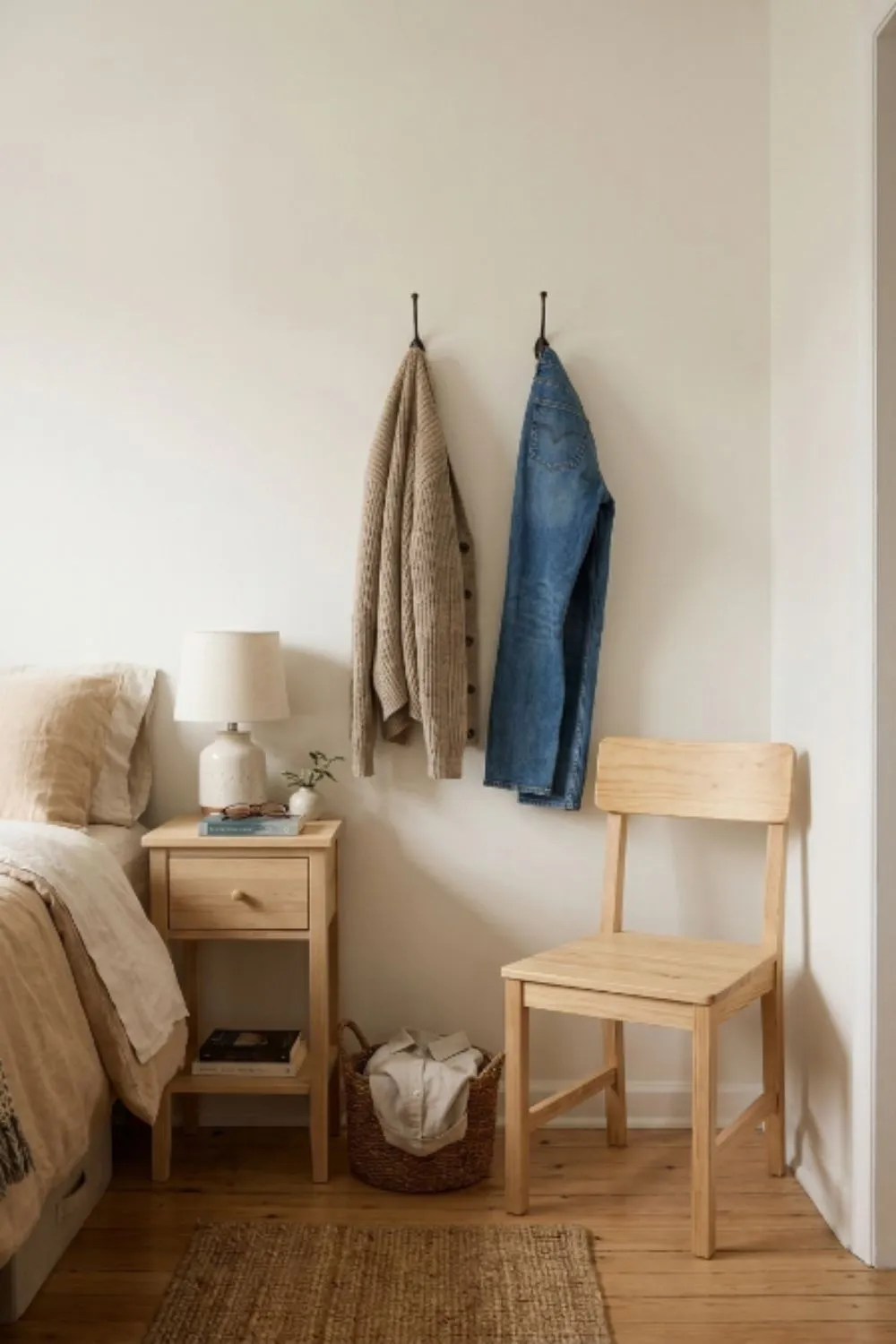
Your nightstand is the first surface you see in the morning and the last surface you see at night. It should hold what you need at night and nothing else. This section is about the nightstand habit, not about nightstand storage capacity. For drawers, shelf options, and what fits inside, see small bedroom storage ideas.
Keep one clear surface on the nightstand. Pick the items that earn a permanent spot: a lamp or wall light, a water glass, your phone charger, and one book or one small tray. Everything else leaves at night. A nightstand with four items is easy to reset. A nightstand with twelve items is a small shelf that never gets cleared.
Use a nightly reset. Before bed, return each item to its home. Put the book back, move the glass to the kitchen or the sink, and coil the charger. The reset takes a minute. It also sets up the next morning, because you wake to a clear surface instead of yesterday’s clutter.
If your nightstand keeps filling, check the habit, not the furniture. Ask where each extra item came from. A pile of receipts came from your pockets. A stack of mugs came from drinks you did not carry out. A tangle of cables came from chargers with no home. Fix the home or the habit, and the nightstand stays clear.
5. Keep One Surface Intentionally Clear
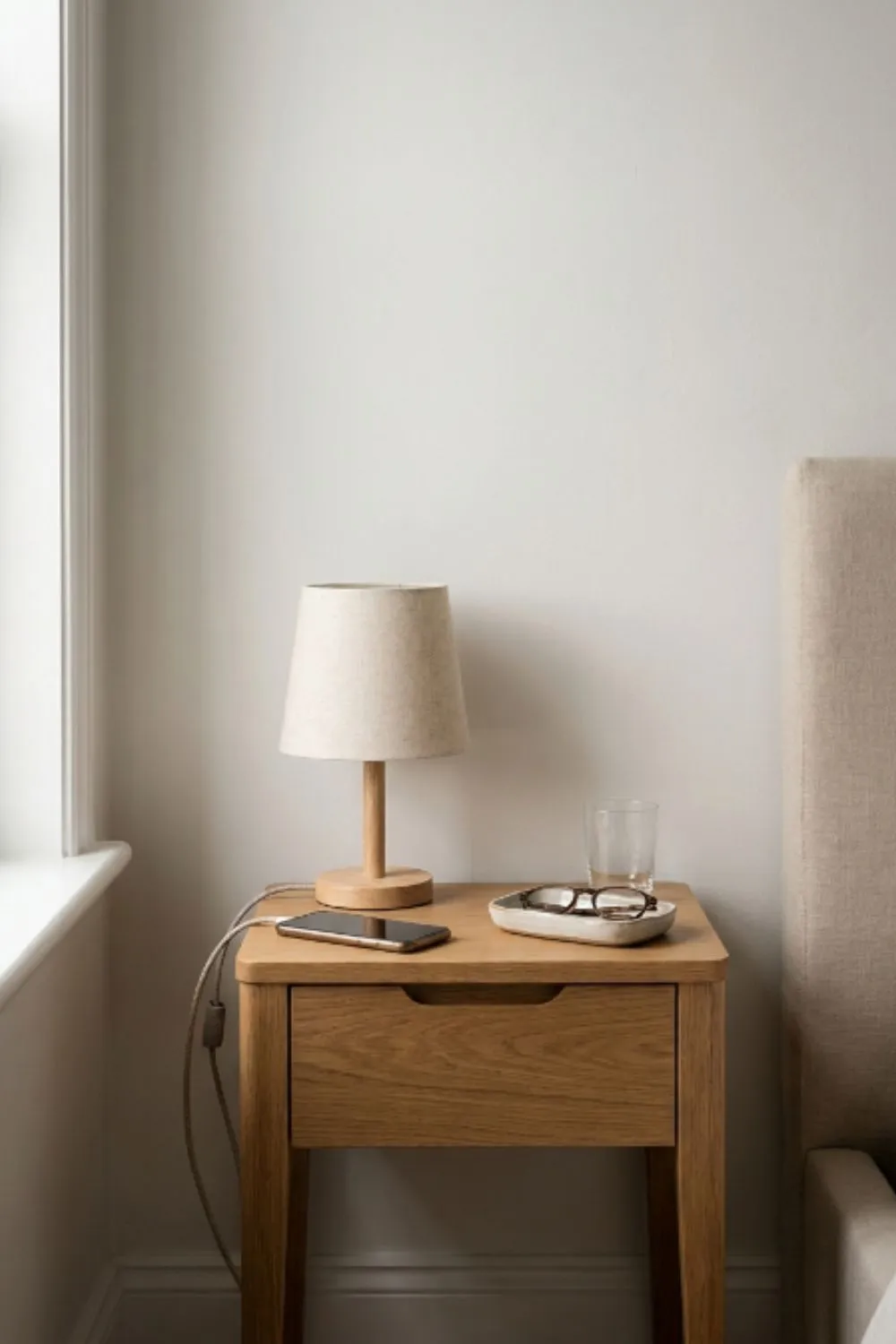
What are some easy ways to organize a small bedroom? Start with one clear surface. Pick one surface, such as the top of the dresser or one side of a desk, and keep it clear on purpose. It is not empty because you have nothing to put there. It is empty because a clear surface gives the room breathing space and gives you a place to set something down without starting a pile.
Protect that surface with a rule: nothing lives there. Items can land there for a moment, then they move to their home. A bag can sit there while you unpack it. Mail can sit there while you sort it. At the end of the day, the surface is clear again. If an item stays for more than a day, it needs a real home somewhere else.
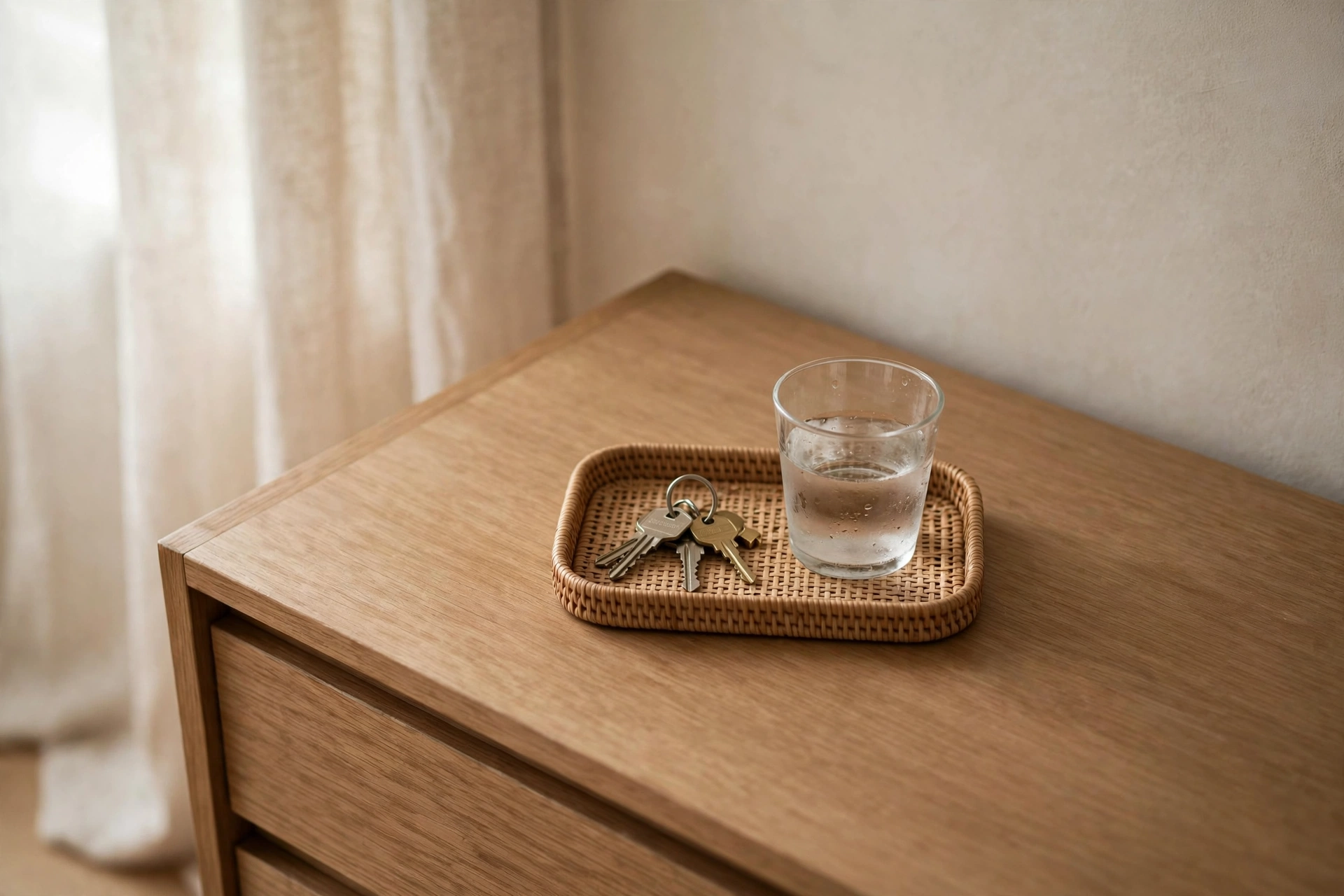
Use a tray to make the rule easier. One small tray can hold the few items that tend to drift: keys, a watch, or a lip balm. The tray gives those items a boundary. When the tray is full, it is time to put things away. When the tray is empty, the surface looks calm again.
For one clear surface that stays clear, keep one plant plus one tray, and let the rest of the surface stay empty. For plant placement that does not add clutter, including common mistakes and a weekend setup, see greenery bedroom ideas. For color that does not add clutter, such as bedding or one object in fewer colors with more texture, see earthy bedroom ideas.
6. Give Every Drawer One Clear Job
A drawer with one job is easy to use. A drawer with three jobs is a drawer you avoid. Assign each drawer one category: sleepwear, everyday tops, workout clothes, or accessories. Write the job on a small note inside the drawer if it helps. The note is not decoration. It is a reminder that keeps the drawer honest.
Keep the job visible by keeping the front of the drawer clear. The items you use most go at the front. The items you use less go at the back. When you open the drawer, you should see what you need without moving other items. If you have to dig, the drawer is holding too much or the wrong category.
When a drawer starts to mix categories, fix it in the same moment you notice it. Move the stray items to their correct drawers. Do not wait for a big cleanout. Small fixes keep drawers working. Big cleanouts happen because small fixes did not.
This section is about the drawer habit: one job, one front row, one quick fix. For drawer dividers, inserts, and storage capacity, see small bedroom storage ideas.
7. Fold Clothes for Visibility, Not Perfection
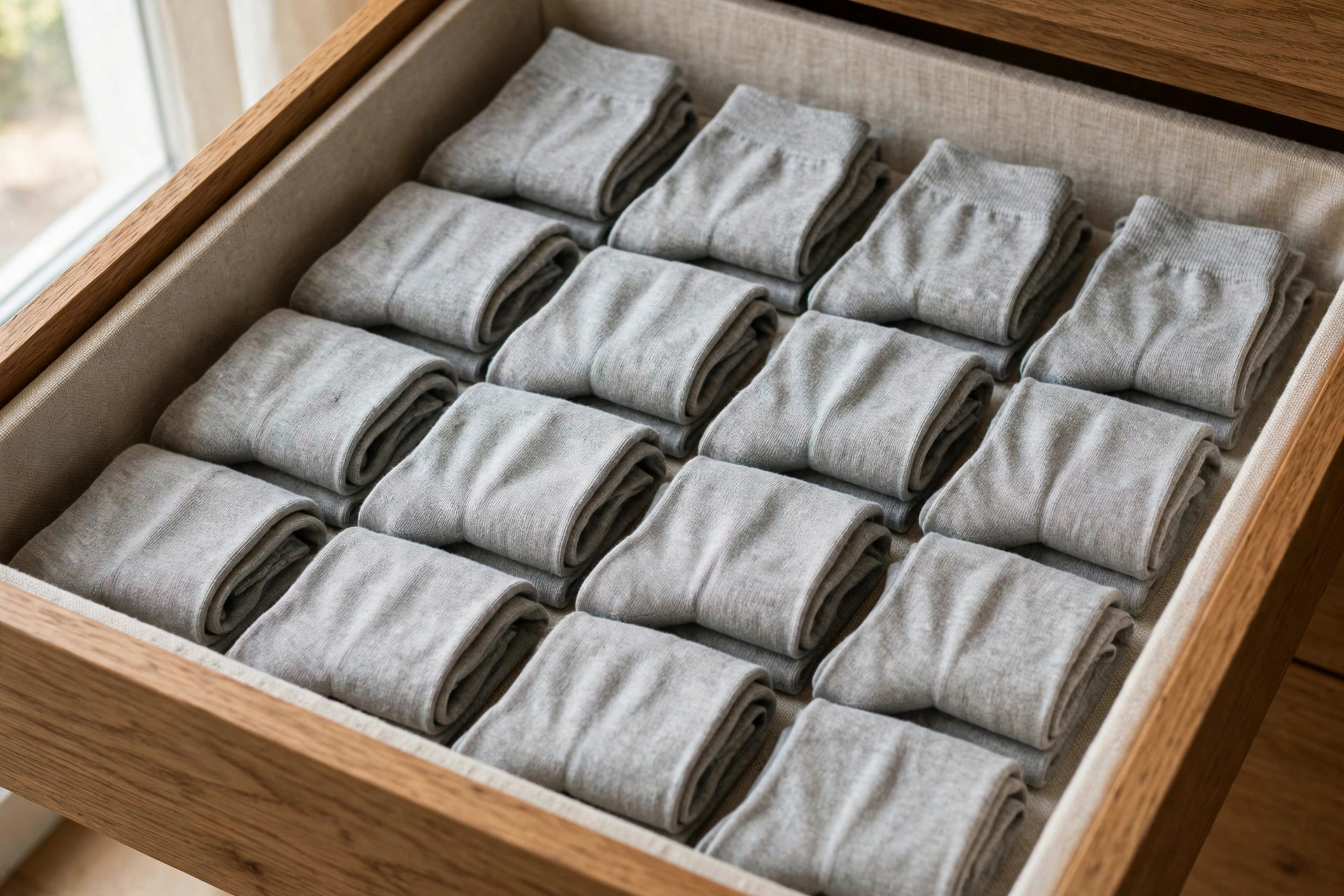
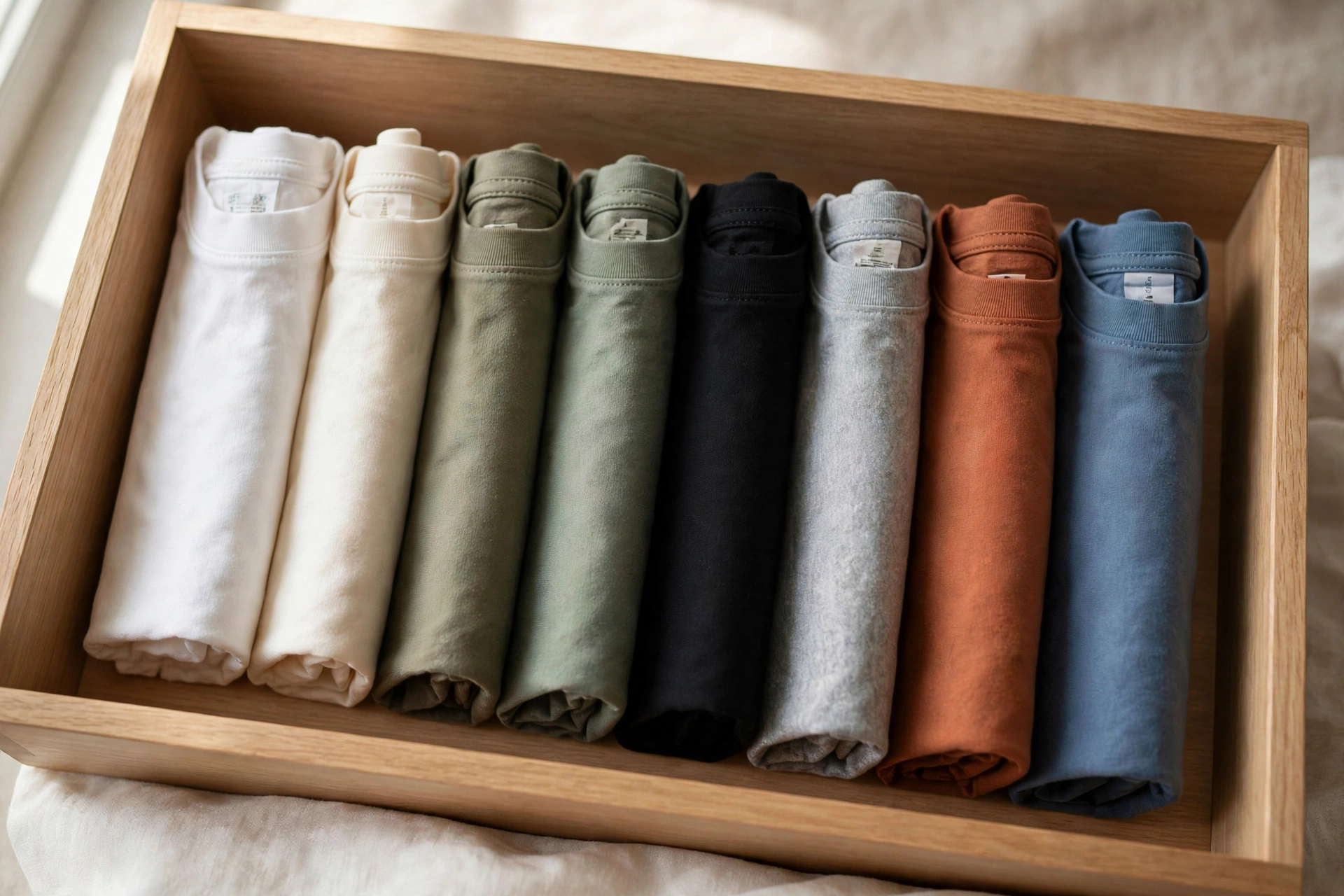
Fold clothes so you can see them. Stacked piles hide the item at the bottom. When you cannot see it, you forget it, and you buy or reach for something else. Folding for visibility means you file clothes upright, like files in a drawer, so each item shows its edge. You can see every item at a glance.
You do not need perfect folds. You need consistent folds. Fold each item to roughly the same width so the rows stay neat. Leave a little space at the end of each row so you can pull one item out without disturbing the rest. If a drawer is so full that you cannot pull one item out, it is too full, no matter how neatly it is folded.
Use visibility as the test for other categories too. If you open a drawer and cannot see the category you want, the drawer needs fewer items or a different home. Visibility is not about pretty drawers. It is about finding things without making a mess.
8. Use Under-Bed Storage for Lower-Frequency Items
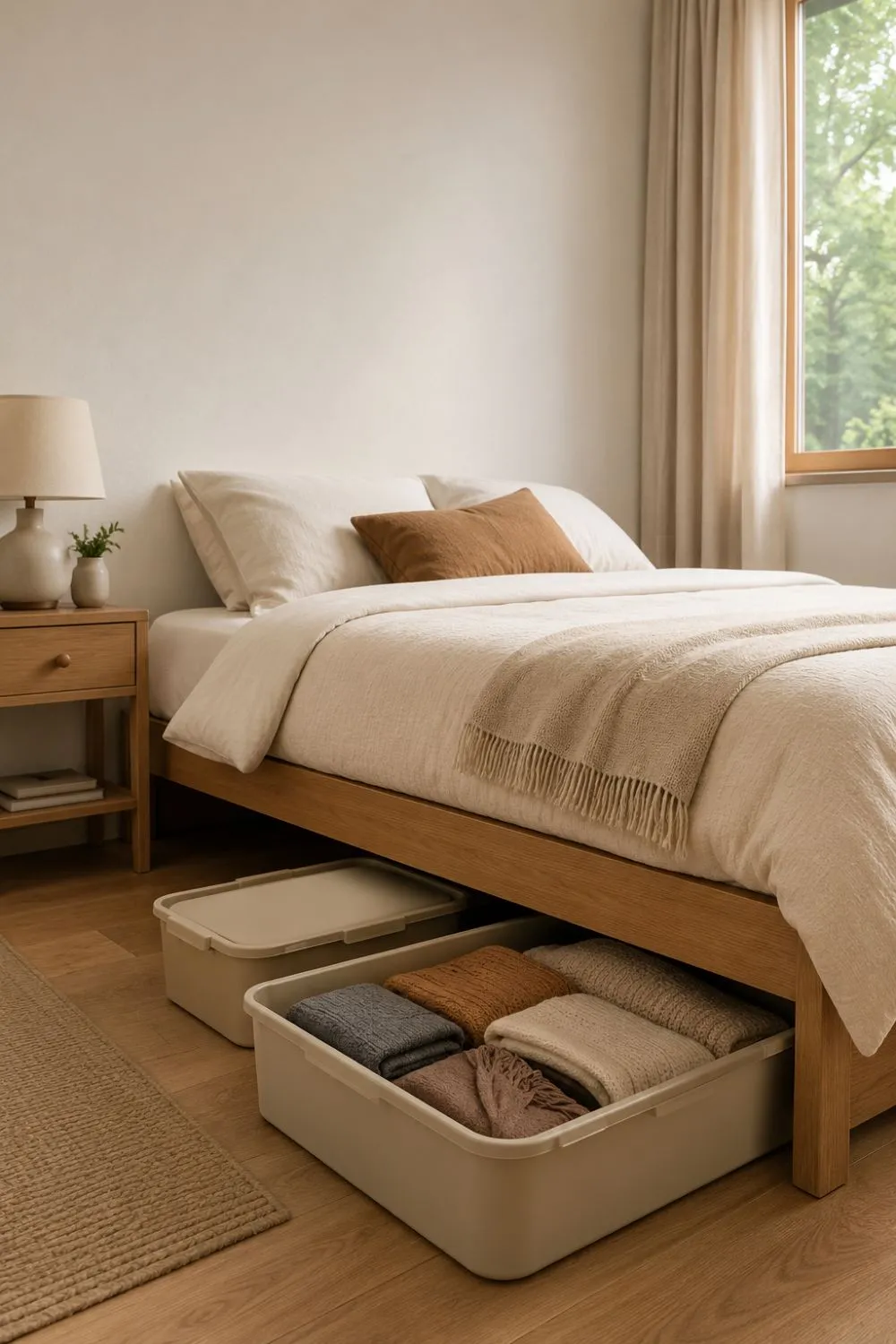
Under-bed storage works best for lower-frequency items only. Think seasonal clothes, spare bedding, or luggage you use a few times a year. Daily items do not belong under the bed, because pulling out a bin every morning is a habit that will not last.
For the full capacity guide, including bins, what goes where, and how to choose under-bed storage, see small bedroom storage ideas. This post keeps the habit rule: if you need it every day, it does not live under the bed.
9. Use Vertical Space Without Covering Every Wall
Vertical space helps in a small bedroom, but only when it has a limit. This post owns the limit, not the full capacity plan. For shelves, hooks, and high storage options, see small bedroom storage ideas. For vertical lines as part of layout, see small bedroom ideas.
Use this limit rule: leave at least one wall, or one large part of a wall, mostly clear. When every wall is covered with shelves and hooks, the room feels busy, even if it is technically organized. One clear stretch of wall gives your eyes a rest and makes the room feel larger.
Hang items you use, not items you are storing. A hook with a bag you carry daily earns its place. A shelf with a plant you enjoy earns its place. A wall covered with items you rarely touch is storage pretending to be decor. Move those items to closed storage or another room.
Check vertical storage with a simple question: can you take the item down and put it back with one hand, without moving other items? If not, the shelf is too high, too full, or holding the wrong level. Daily items belong at arm height. Rarely used items belong up high.
10. Stop Using the Closet as a Storage Black Hole
A closet becomes a black hole when everything goes in and nothing comes out in order. The fix is not a bigger closet. It is a clear rule for what lives inside, and a habit that keeps it that way.
Give the closet one job: clothes and the items you wear with them. If the closet also holds luggage, gift wrap, old electronics, and seasonal boxes, it cannot do its main job well. Move non-clothing categories to their own homes. The closet gets calmer the moment it stops holding everything.
Use the frequency system inside the closet too. Daily clothes go at eye level and within easy reach. Weekly clothes go to the side or on a lower shelf. Rarely worn clothes go up high or to another space. When you open the closet, the first items you see should be the ones you wear most.
Do a monthly closet check. Pull out anything you have not worn in the past month and ask whether it still earns closet space. If it is seasonal, move it to lower-frequency storage. If you no longer wear it, donate it. If it belongs elsewhere, relocate it. A five-minute check keeps the closet from filling again.
For closet capacity, such as improving the closet before buying another dresser, see the storage guide. This post keeps the habit: one job, frequency order, and a monthly check.
11. Give Shoes a Clear Limit
Shoes spread fast in a small bedroom. One pair by the door becomes three pairs by the bed, then a row along the wall. The fix is a limit you choose, not an ideal number from someone else.
Pick one number for shoes that live in the bedroom. The number should fit your room and your life. If you have a small closet, the number may be small. If you have a hall closet, most shoes can live there, and only one or two pairs stay in the bedroom. The right number is the one you can keep. Write it down, and stick to it.
Give shoes one home. That home can be a shelf, a small rack, or one bin. When the home is full, one pair leaves before a new pair enters. This is the one-in-one-out rule applied to shoes. It keeps the floor clear without a big cleanout.
Keep everyday shoes near the door or near where you get dressed, not scattered across the room. If you have to walk across the bedroom to find shoes, they will end up on the floor. A clear limit plus one home beats a large shoe collection with no home.
12. Put the Laundry Hamper Where Clothes Actually Come Off
Laundry piles up where clothes come off, not where the hamper looks tidy. If your hamper is across the room, clothes will land on the chair, the bed, or the floor. Put the hamper where you actually change clothes. That one move can clear the chair faster than any new organizer.
Build the laundry loop, not just the hamper. The loop has four steps: dirty clothes go in the hamper, clean clothes come out of the wash, clean clothes get put away the same day, and the hamper stays empty enough to use. A hamper that is always full is not a system. It is a pile with a container around it.
Keep clean laundry from becoming clutter. Do not leave a basket of clean clothes on the bed or the floor. Put clean clothes away the same day, even if it takes only a few minutes. Clean laundry left out becomes a new pile, and a new pile becomes a reason to avoid the room.
If you share the room, agree on one hamper location and one rule: dirty clothes go in the hamper, not on the floor or the chair. A shared habit only works when both people use the same home. For renter-friendly laundry and reset habits in shared apartment bedrooms, see small apartment bedroom ideas.
13. Create Micro-Zones for Small Accessories
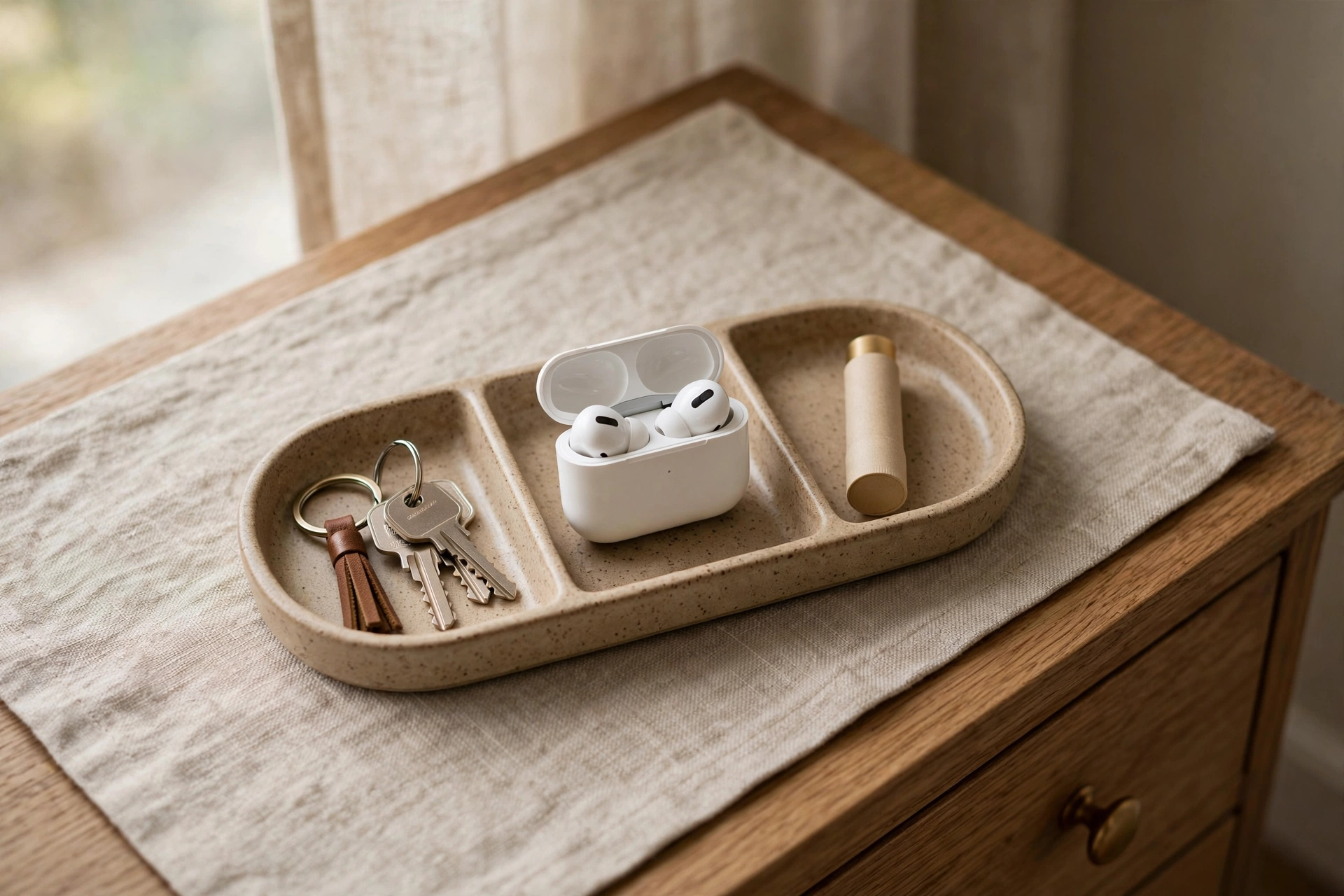
Small items cause outsized clutter. One charger, one set of keys, one pair of earbuds, and a few small bottles can make a surface look messy even when the room is otherwise tidy. Tiny objects create visual interruption because each one is a separate item to notice. Five small items on a dresser look busier than one large item in the same space. The fix is a micro-zone: one small, defined home for one small category.
Create micro-zones for the small items you use every day:
- Chargers: one tray or one small box near an outlet. Cables coil inside, not across the floor.
- Keys and everyday carry: one hook or one small dish by the door or on the dresser. Keys, wallet, and one bag live here.
- Meds and daily care: one small pouch or one small box in a drawer. Daily items stay together, and the surface stays clear.
- Small accessories: one small tray for earrings, a watch, or a hair tie. When the tray is full, it is time to put items away.
Each micro-zone has one job, one place, and one boundary. The boundary matters. A tray that holds three items works. A tray that holds fifteen items is a new pile. When a micro-zone overflows, it is a signal to put things away, not a signal to buy a bigger tray.
14. Group Similar Items Into Simple Zones
Grouping is different from micro-zones. Micro-zones hold tiny everyday items. Zones hold larger categories by activity. Grouping answers one question: where do I do this, and where do the items for it live?
Use a few simple zones, not many. For most small bedrooms, three or four zones are enough:
- Sleep zone: bed, nightstand, and sleep items. Keep it calm and clear.
- Get-dressed zone: closet, dresser, and re-wear zone. Keep daily clothes within easy reach.
- Work or read zone: desk or reading chair, plus the few items you use there. If you do not work in the bedroom, skip this zone.
- Exit zone: bags, keys, and shoes near the door. Keep it ready for leaving, not for storing.
When an item lives in the wrong zone, it creates extra steps. A charger in the sleep zone is fine. A charger in the get-dressed zone means you walk across the room to plug in your phone. A bag in the exit zone is easy to grab. A bag on the bed is in the way. Zones work when they match how you move through the room.
Do not create a zone for every activity. Too many zones become clutter with labels. Start with three zones. Add a fourth only when one activity keeps spreading into other zones. If an item does not fit any zone, it may not belong in the bedroom.
15. Choose Furniture That Replaces Something Else
In a small bedroom, new furniture should replace something, not add to the room. Before you buy, name what leaves. A new storage bench replaces a chair. A new nightstand with drawers replaces a small table. A new bed with drawers replaces a dresser. If nothing leaves, the room gets fuller, not better organized.
Use this test before buying: does it replace something, free floor space, or give a category a home? If it does none of those three, skip it. A product that looks like storage but only adds another surface is not saving space. It is adding a new place for clutter to land.
For layout questions, such as whether a piece fits and where it should go, see the layout guide. For capacity questions, such as whether a piece holds enough and what goes inside, see small bedroom storage ideas. This post keeps the habit rule: one piece in, one piece out.
16. Use Labels Only Where They Save You Time
Labels help when they save time. They hurt when they add work. Use a label only when it answers a question you ask often, such as which bin holds chargers, or which drawer holds sleepwear. If you already know what is inside, you do not need a label.
Here are two examples that show the difference:
- Helps: a label on a closed bin that holds seasonal clothes, so you do not open three bins to find one item. The label saves time because the bin is closed and the contents are not visible.
- Hurts: a label on every open basket, drawer, and shelf, including items you use daily. The labels add visual noise, and you spend time making and updating them instead of putting items away.
Keep labels short and plain. Use the category name, not a sentence. Use labels on closed storage and shared spaces, where another person needs to find things. Skip labels on open storage you use every day. If a label feels like upkeep, remove it. The best label is the one you never have to update.
17. Give Bags and Everyday Accessories a Landing Spot
Bags land where you drop them. Without a landing spot, a bag lands on the bed, on the floor, or on a chair. With a landing spot, the bag lands in one place, and the rest of the room stays clear.
Pick one landing spot for bags and everyday accessories. A single hook on a wall or door works for one daily bag. A small basket works for a bag plus a tote. The rule is one spot, not three. A hook with two bags is a landing spot. A hook with fifteen overloaded bags is a pile on a wall. When the hook is full, bags go to their full home in the closet or on a shelf.
Build a small unpack habit. When you come home, hang the bag, take out what you need, and put the rest away. Do not leave the bag packed on the bed. A bag that stays packed becomes a second storage spot, and a second storage spot becomes clutter.
If you share the room, give each person one hook or one basket. Shared hooks fail because no one knows whose bag is whose, and neither person wants to move the other person’s bag. One hook per person keeps the habit simple.
18. Keep the Floor as Clear as Possible
Floor space is the most visible space in a small bedroom. A clear floor makes the room feel larger and calmer. A floor with shoes, bags, and laundry makes the room feel crowded, even if the furniture is the same.
Use one rule: the floor is for walking and for furniture, not for storage. Shoes go to their home. Bags go to their hook. Laundry goes in the hamper. Items that do not have a home get a home or leave the room. The floor is not a home.
Check the floor at the end of the day. If something is on the floor, ask why. Was the hamper full? Was the shoe home full? Was the bag hook full? The floor tells you which habit failed. Fix that habit, not the floor.
For layout help, such as walking path and furniture placement that keeps the floor clear, see small bedroom ideas.
19. Avoid Turning Every Storage Solution Into Decor
Not every storage solution needs to be visible. Open baskets, open shelves, and clear bins show everything inside. When everything is visible, the room looks busy, even if it is organized. Closed storage hides the complexity. Open storage shows it.
Use closed storage for categories that naturally look messy. Examples: chargers and cables, small accessories, papers, and mixed everyday items. Use open storage for categories that look calm and intentional. Examples: a few books, one plant, or a neatly folded throw. When in doubt, close it.
Do not buy storage for how it looks in a photo. Buy storage for how it works in your room. A pretty basket that holds mixed items will look messy in a week. A plain closed bin that holds one category will look tidy for months. The room feels calmer when fewer items compete for attention.
20. Make the Bed Easy to Reset
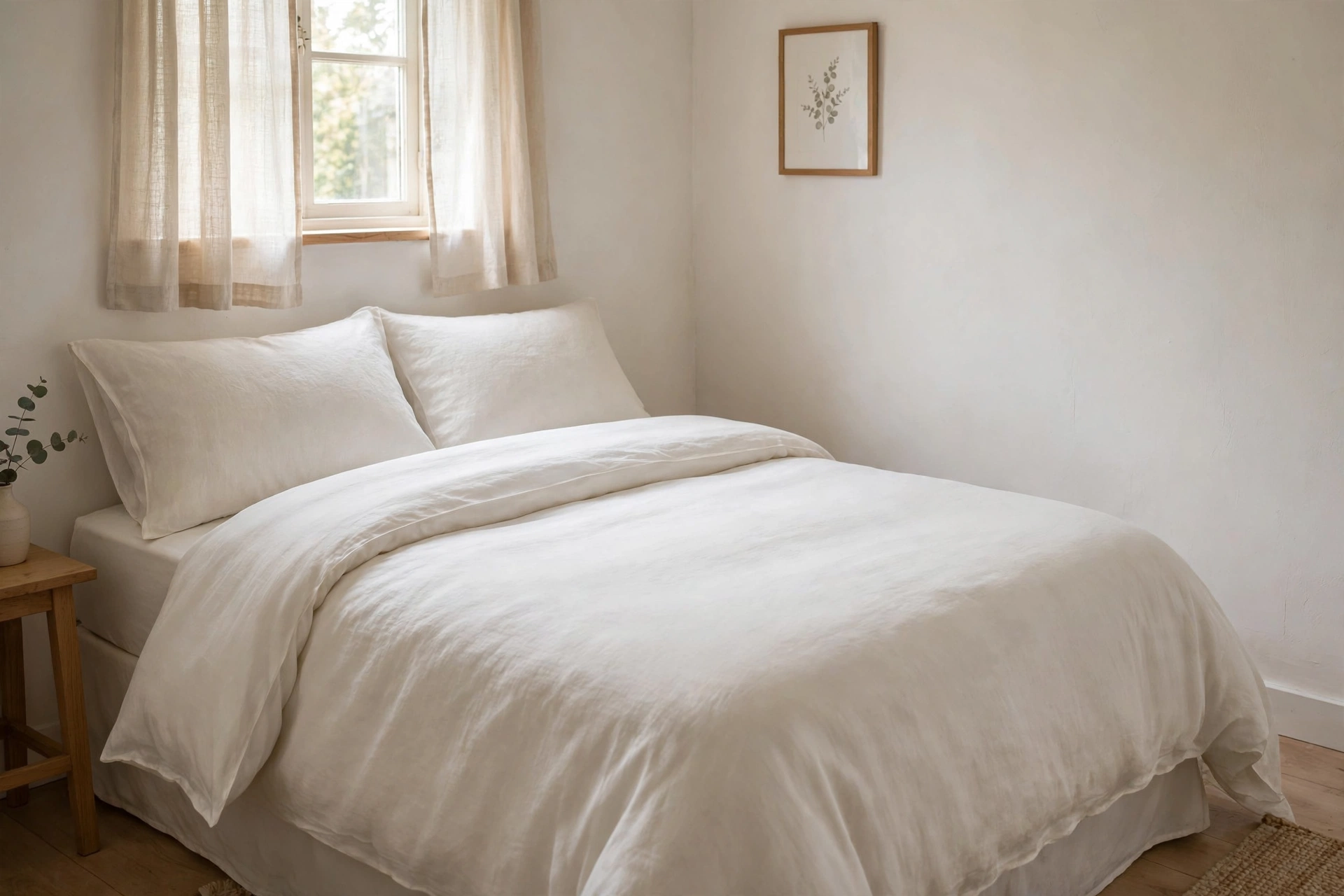
The bed is the largest surface in a small bedroom. When the bed is made, the room looks tidy. When the bed is unmade and covered with clothes, the room looks messy, even if everything else is put away. Make the bed easy to reset, and the whole room gets easier.
Keep bedding simple. Fewer pillows mean a faster reset. If the bed has so many pillows that you spend minutes moving them every night, remove a few. Keep the pillows you use for sleep and one or two for reading. The rest are decoration that costs time every day.
Do not use the bed as a landing spot. Clothes, bags, and laundry do not belong on the bed, even for a moment, because a moment becomes an hour, and an hour becomes a pile. Put items in their homes, not on the bed.
Build a two-minute bed reset. Pull the sheet up, smooth the duvet, place the pillows, and clear the bed surface. Do it in the morning, or do it before bed if mornings are rushed. The point is not a perfect bed. The point is a clear bed surface that makes the room feel done.
21. Build a Five-Minute Bedroom Reset
A five-minute reset is the habit that holds all the other habits together. It is a short, daily routine that returns the room to its starting state. It is not a deep clean. It is a reset. When you can reset the room in five minutes, the system works. If the reset takes twenty minutes, the system is holding too much, or too many items have no home.
Use this reset order. Work from the largest surface to the smallest:
- Clear the bed. Put clothes, bags, and laundry in their homes.
- Clear the floor. Shoes to their home, bags to their hook, laundry to the hamper.
- Clear the one clear surface. Return items to their homes, and leave the surface empty.
- Clear the nightstand. Return extra items, and leave one clear surface.
- Reset the re-wear zone. Hang or bin lightly worn clothes, and move dirty clothes to the hamper.
Set a timer for five minutes. If you finish early, stop. If you do not finish, note which step took longest. That step is the habit to fix next. A reset that always stalls on laundry means the hamper or the laundry loop needs work. A reset that always stalls on the dresser means the one clear surface rule needs work.
Add a weekly reset. Once a week, spend 15 minutes on the jobs that do not fit the daily reset:
- Put away clean laundry that is still out.
- Return items that drifted to the wrong zone.
- Empty one micro-zone that is full, such as the charger tray or the small accessories tray.
- Check the closet for items that no longer earn their place.
- Wipe one surface, and take out any trash or recycling.
Daily reset plus weekly reset is the full routine. Daily keeps the room usable. Weekly keeps the room from drifting. Neither one needs to be perfect. Both need to be regular.
Mistakes to Avoid
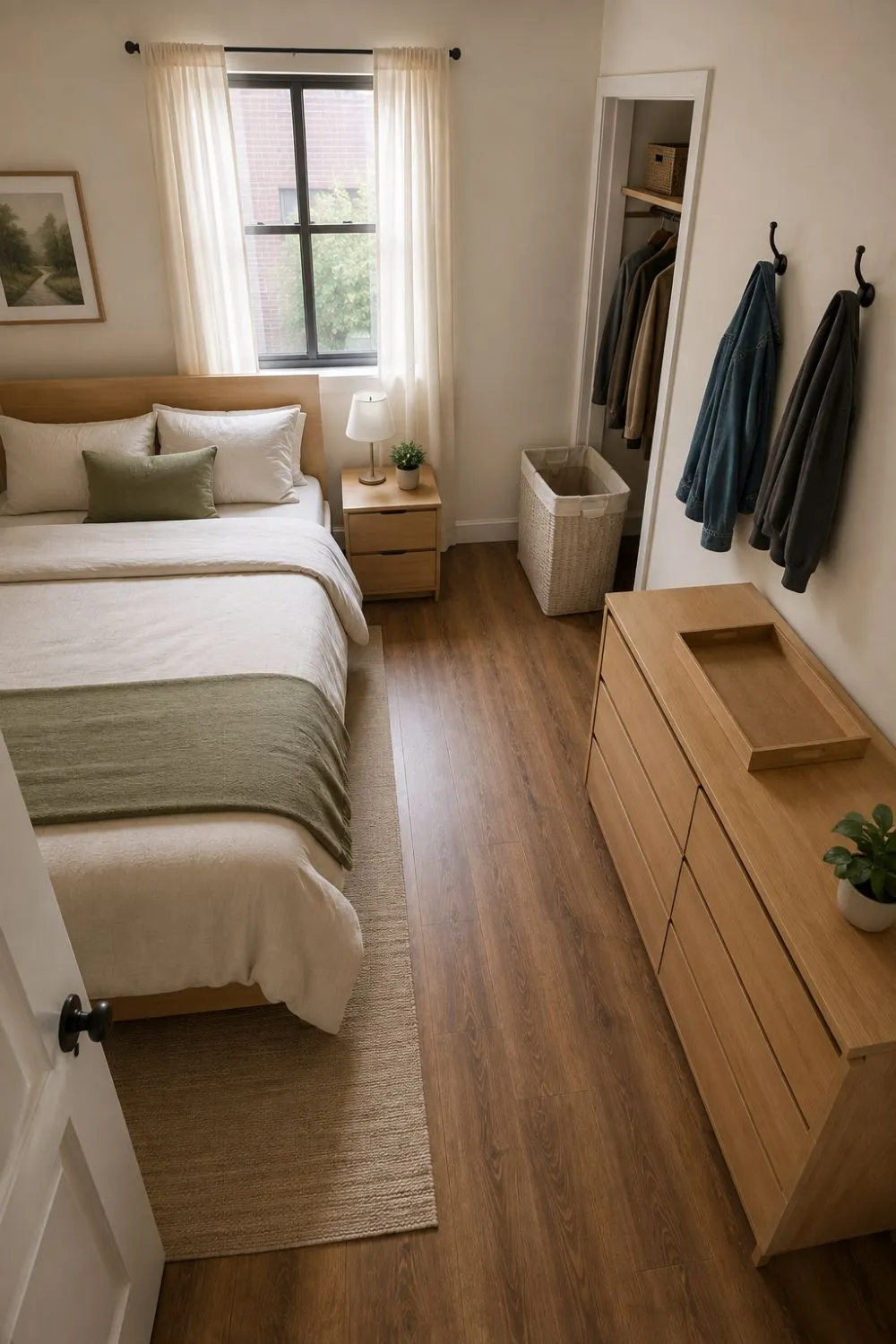
These mistakes show up in many small bedrooms. They are not failures. They are signs that a habit needs a home.
- Buying organizers before choosing categories. Organizers work when each one holds one category. When you buy first, you end up with bins that hold mixed items, and mixed bins become clutter. Choose the category, then choose the container.
- Adding storage instead of removing items. More storage can hide the problem for a while, but it does not fix it. When storage is full, remove, relocate, or replace, not add.
- Putting daily items out of reach. Daily items belong at arm height and near where you use them. When daily items live up high or under the bed, you stop putting them away.
- Filling every wall. Vertical storage helps, but a room with every wall covered feels busy. Leave one wall, or one large part of a wall, mostly clear.
- Skipping the reset. A system without a reset drifts. Five minutes a day keeps the system working. No reset means the room slowly returns to clutter.
- Shopping when a habit is the problem. Habits diagnose better than shopping. If the chair keeps collecting clothes, the fix is a re-wear home and a daily decision, not a new chair or a new bin. Shopping feels like progress, but a habit is what changes the chair. Try the habit first, then decide whether you need to buy anything.
How to Organize in the Right Order
Use this order so each step supports the next. Do not jump to containers before you have cleared and assigned homes.
- Pick your three repeat clutter zones. Name them in plain language, such as chair, dresser top, and floor by the bed.
- Declutter one category. Use keep, donate, or relocate, with a 20-minute time box.
- Assign frequency levels. Put daily items within easy reach, weekly items one step away, and rarely used items out of the way.
- Give each category one home. Re-wear clothes, bags, chargers, shoes, and laundry each get one spot.
- Set limits. Pick a shoe number, a re-wear hook limit, and a tray limit. Limits keep homes from overflowing.
- Build the five-minute reset. Run it daily, and add the 15-minute weekly reset.
- Fix the slowest step. After a week, notice which reset step takes longest, and fix that habit first.
FAQs
How should a bedroom be organized?
Start with frequency. Put daily items within easy reach, weekly items one step away, and rarely used items out of the way. Then give each category one home, and build a five-minute daily reset. That order matters more than any single container.
What are some easy ways to organize my bedroom?
Pick one clear surface and keep it clear. Give lightly worn clothes one transition zone. Put the hamper where clothes actually come off. Give bags one hook. Run a five-minute reset each day. These five habits clear most visible clutter without buying anything new.
What to put in a small empty space in a bedroom?
Leave it empty unless it has a job. A small empty space can stay empty, or it can hold one item with a clear purpose, such as a hamper where clothes come off, or a small tray for keys. Do not fill an empty space just because it is empty. Empty space is what makes a small room feel calm.
How do I keep a small bedroom tidy when I share it?
Agree on shared homes and shared limits. One hamper location, one re-wear zone each or one shared zone with a clear limit, and one hook per person for bags. Run the same five-minute reset. A shared system works when both people use the same homes. For renter-friendly shared bedroom ideas, see small apartment bedroom ideas.
How often should I declutter a small bedroom?
Run a short declutter pass when a drawer gets tight or a surface starts to fill again. A 20-minute pass on one category is enough. Add a monthly closet check and a weekly 15-minute reset. Regular small passes beat rare big cleanouts.
Do I need more storage to organize a small bedroom?
Not always. Start with fewer items, one home per category, and a daily reset. If a category still has no home after that, then consider one storage piece that replaces something else. For capacity options, see small bedroom storage ideas.
The Best System Is the One You Can Reset
The best system is the one you can reset in five minutes. It does not need to be perfect. It needs to be repeatable. Pick your three clutter zones, give each category one home, set a few limits you can keep, and run the daily reset. When the reset gets slow, fix the slowest step. When a category has no home, give it one. When a drawer gets tight, run a short declutter pass.
Small bedroom organization is not about owning less for its own sake. It is about making the room easy to use. A room you can reset is a room you can rest in. Start with one zone today, then add the next habit tomorrow.