
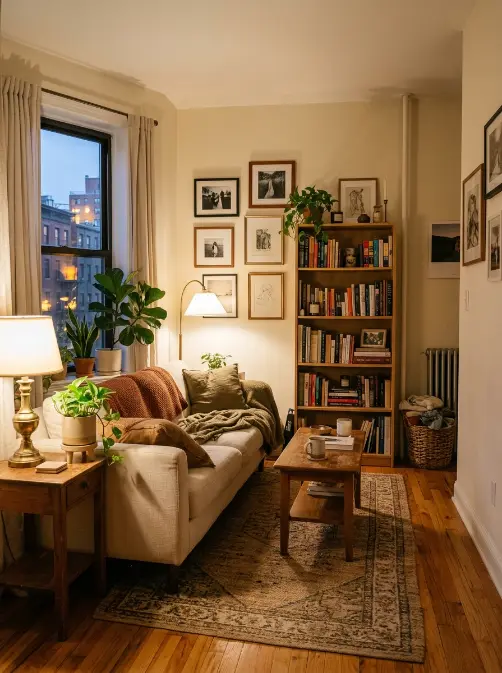
A cozy small apartment aesthetic is not created by filling every empty corner with pillows, baskets, plants, and candles.
The apartments that feel most inviting usually have something more deliberate going on: warm light at different heights, a few tactile materials, colors that repeat from room to room, useful furniture, personal objects, and enough empty space for everything else to breathe.
That distinction matters even more in a small home. When square footage is limited, every decorative choice becomes more noticeable.
The goal is therefore not more decor. It is to make the apartment feel softer, warmer, more personal, and more comfortable with the space you already have.
Use these ideas as a sequence rather than a shopping list. Start with lighting and the largest surfaces, add texture and personality, then stop before cozy turns into crowded.
What Makes a Small Apartment Feel Cozy?
Coziness comes from several elements working together.
Think about:
- soft, layered lighting
- comfortable textures
- warm or grounded colors
- natural-looking materials
- furniture that suits the room’s scale
- curtains and rugs that soften hard surfaces
- familiar books, art, photographs, and objects
- visually calm storage
- spaces that support everyday rituals
- enough breathing room to enjoy everything you have added
You do not need all of these in every room.
A compact living area might gain most of its warmth from a rug, table lamp, books, and textured sofa. A bedroom might rely more heavily on bedding, curtains, bedside light, and one warm wood piece.
The useful question is not, “What else can I add?”
Ask:
What currently makes this space feel cold, unfinished, or impersonal?
Then solve that first.
1. Start With Warm, Layered Lighting
Lighting may be the fastest way to change the atmosphere of a small apartment.
Many apartments rely heavily on one ceiling fixture. That can provide practical illumination, but it rarely creates much visual depth on its own.
Instead, bring light down into the room.
A living space might combine:
- a floor lamp beside the sofa
- a table lamp on a console
- a small task lamp at a desk
- soft bedside lighting in the bedroom
The different heights create separate pockets of light rather than illuminating everything in exactly the same way.
That immediately helps a compact apartment feel more layered.
You also gain more control over the mood. Bright general lighting can still be useful when cleaning or working, while softer lamps can make the same room more relaxing later.
If your rental has unattractive permanent fixtures, portable lamps let you change much of the experience without altering the electrical system.
2. Choose a Warm, Limited Color Palette
A cozy apartment does not need to be beige.
But using a limited family of colors helps a small space feel more connected.
You might build the apartment around combinations such as:
Warm neutral: cream, camel, medium wood, chocolate brown
Earthy: warm white, olive, rust, terracotta
Soft vintage: ivory, muted rose, sage, dark wood
Moody: warm gray, brown, burgundy, soft black
Colorful cozy: butter yellow, dusty blue, warm red, natural wood
Choose a few tones and allow them to reappear throughout the apartment.
For example, a muted green might appear in a living room pillow, a kitchen towel, bedroom artwork, and a small decorative object.
They do not need to match exactly.
The repetition is what makes separate rooms or zones feel related.
3. Add Texture Before Adding More Accessories
When a room feels flat, the instinct is often to buy another decorative object.
Texture can solve the problem with less clutter.
Look at surfaces you already need:
- bedding
- curtains
- sofa upholstery
- rugs
- pillow covers
- blankets
- baskets
- lampshades
Introducing texture through those surfaces gives the apartment more visual depth without taking up additional floor space.
For example, a simple neutral sofa might feel much warmer when paired with a woven rug, linen-look curtains, one textured pillow, and a soft throw.
The room has not gained many objects. It has gained more variety in how the existing objects look and feel.
This is particularly useful in a tiny apartment where every additional accessory needs somewhere to live.
4. Make the Rug One of the Main Cozy Layers
Hard floors can make a compact apartment feel visually colder, especially when the furniture is sparse.
A rug adds softness while also helping define a room or zone.
In an open-plan apartment, it can visually establish the living area without requiring a divider. In a bedroom, it can soften the floor around the bed. In a studio, different floor treatments can help separate sleeping and living functions.
Avoid automatically buying a tiny rug because the apartment is small.
A rug that relates properly to the main furniture often makes a room feel more settled than one floating alone in the center.
Before buying, map out the proposed footprint on your actual floor so you can judge the proportion against the sofa, bed, doors, and walking routes.
5. Bring Warm Wood Into the Apartment
Wood can introduce warmth without requiring a strong color commitment.
You do not need matching wooden furniture.
In fact, a small apartment can feel more collected when wood appears in several smaller ways:
- a side table
- picture frames
- a dresser
- shelving
- a stool
- a lamp base
- a tray
- a vintage cabinet
Try repeating a related warm undertone rather than purchasing an entire matching furniture set.
If most of your apartment consists of cool white walls, gray flooring, or metal finishes, even one or two visible wood pieces can make the room feel less stark.
6. Soften the Windows With Curtains
Windows contribute a large amount of visual space to a room.
Leaving them completely bare may suit some decorating styles, but curtains can immediately make an apartment feel softer.
They add:
- fabric
- movement
- vertical lines
- color or pattern
- visual warmth
Choose them according to what the room actually needs, including privacy and light control.
In a small room, avoid using so much fabric that the window becomes overwhelmed.
The goal is to soften the architecture while still allowing the window to contribute light and openness.
Renters should use an installation method permitted by their lease or building rules.
7. Let Your Sofa Look Comfortable
A cozy living room needs comfortable seating before it needs decorative styling.
Start with the sofa or primary chair.
Then add only enough textile layers to make it inviting.
That might mean:
- two or three useful pillows
- one throw
- a nearby side table
- a lamp within easy reach
You do not need ten matching cushions to communicate coziness.
In fact, excessive pillows can turn a compact sofa into a place where there is barely enough room to sit.
Keep the seating physically usable.
Coziness should improve comfort, not interfere with it.
8. Make the Bed a Major Part of the Aesthetic
In a small apartment bedroom, the bed occupies a large percentage of what you see.
Use that to your advantage.
Instead of covering every wall and tabletop with decor, let the bedding carry much of the room’s style.
Try combining a few complementary layers:
- simple sheets
- a quilt, duvet, or coverlet
- one tactile throw
- a limited number of pillows
- a headboard if appropriate
The bed can establish the entire palette.
A cream duvet with an olive throw and dark wood bedside table immediately gives the room a warm direction. A rust-colored quilt with muted floral artwork can create a more vintage mood.
Making the largest object beautiful reduces the pressure to decorate everything around it.
9. Create One Cozy Corner
A small apartment does not need several styled “moments.”
One strong cozy corner can do much more.
Look for an existing place you naturally enjoy using:
- one end of the sofa
- a chair near a window
- the end of a dining bench
- a bedside corner
- a small reading chair
- a section of the kitchen where you make coffee or tea
Then improve that specific area.
A reading corner, for example, may need only a comfortable chair, useful lamp, small surface, and nearby books.
This is more effective than scattering decorative objects around the entire apartment without creating a place where you actually want to spend time.
10. Display Books as Part of the Room
Books naturally add variation in color, height, texture, and personality.
They also make an apartment feel inhabited rather than staged.
Use shelves where you already need storage, or keep a small group of books on a side table or console.
Avoid spreading small stacks across every available surface.
A more intentional approach is to concentrate books in one or two areas so they become part of the composition.
You can mix upright books with a horizontal stack, leaving enough open space that the shelf does not become visually dense.
The books should look as though they belong to the person living there—not as though they were purchased as generic props.
11. Add Vintage or Collected-Looking Pieces
A room where every object looks brand new and perfectly coordinated can sometimes feel more like a catalog than a home.
Introducing a few pieces with different character helps soften that effect.
Possibilities include:
- a secondhand side table
- vintage-looking artwork
- an old wooden stool
- a ceramic lamp
- a framed print
- a small cabinet
- handmade pottery
- inherited or sentimental objects
You do not need to turn the apartment into a vintage interior.
One or two pieces with age, texture, or individuality can make otherwise simple furniture feel more personal.
The contrast is often what creates interest.
12. Group Small Decor Instead of Spreading It Everywhere
A common small-apartment mistake is placing one tiny decorative object on every available surface.
One plant on one shelf.
One candle on another.
One frame on another.
One bowl somewhere else.
Individually, each object is small. Together, they can create visual noise across the entire room.
Try concentrating accessories instead.
A console might hold a lamp, two stacked books, and one decorative object while the nearby side table remains mostly clear.
A shelf could contain one group of ceramics while another shelf contains mostly books.
This creates areas of interest alongside areas of calm.
That rhythm makes a small apartment easier to look at.
13. Keep Open Shelves Selective
Open shelving can contribute enormously to the cozy apartment aesthetic because it provides a place for books, ceramics, plants, artwork, and useful objects.
But every shelf does not need to be full.
Leave some breathing room.
Use a mixture of:
- upright items
- lower horizontal objects
- one or two taller elements
- practical storage
- visible empty space
If an object has no useful function and you do not particularly like looking at it, it probably does not deserve valuable open-shelf space.
Use closed storage for visually messy necessities.
Open storage works best when you can afford to be selective about what remains visible.
14. Add Plants Where They Actually Make Sense
Greenery can introduce natural color and organic shapes into a room dominated by straight furniture lines.
But the cozy look does not require turning every apartment into an indoor jungle.
Choose plants according to the real conditions of the room: available light, space, and the level of care you can provide.
A single healthy plant in a good position generally looks better than several struggling plants squeezed into dark corners.
If live plants are not practical, you can bring in similar visual softness through botanical artwork, natural materials, or other organic shapes.
When pets are present, verify that any plant you bring home is appropriate for the household.
15. Use Personal Objects Instead of Generic Filler Decor
One of the strongest differences between an attractive room and a genuinely cozy room is personality.
Use some of what you already have.
That might include:
- photographs
- artwork you genuinely like
- travel souvenirs
- handmade pieces
- records
- books
- framed postcards
- hobby-related objects
- small collections
- family items
You do not need to display everything.
Choose the pieces that contribute both meaning and visual interest.
A small apartment benefits from this approach because every object has more presence. One framed photograph you care about can add more character than several generic decorative prints.
16. Create a Small Everyday Ritual Zone
Coziness is not purely visual.
A home feels inviting when it supports things you enjoy doing there.
Create one small zone around an everyday routine.
For example:
Coffee or tea corner
Group the items you actually use together rather than spreading them across the kitchen.
Reading corner
Keep a comfortable seat, appropriate light, and your current book within reach.
Evening wind-down area
Make one part of the sofa especially comfortable with a useful lamp and blanket.
Morning getting-ready zone
Use a mirror, storage, and good lighting to make the routine easier.
These areas make the apartment feel designed around real life rather than around photographs.
And because the zone has a purpose, the objects within it feel intentional rather than cluttered.
17. Keep Practical Storage Visually Calm
Cozy interiors still need somewhere to put chargers, paperwork, toiletries, cleaning supplies, extra linens, and all the other things that do not look beautiful on an open shelf.
Closed storage is your friend.
Use pieces you already need to hide visual noise:
- a media console with doors
- an ottoman with storage
- a dresser
- baskets inside shelving
- under-bed storage
- an entry cabinet
- boxes for smaller categories
Try to avoid introducing dozens of tiny organizers.
Several larger, understandable storage zones are generally easier to maintain than a separate basket or container for every category.
The goal is not to hide evidence that someone lives in the apartment.
It is simply to prevent everyday necessities from competing with the things you intentionally chose to display.
18. Finish by Removing Something
This may be the most useful cozy-apartment decorating step.
Once you have added lighting, textiles, artwork, storage, and personal objects, edit the apartment again.
Look at each room from its entrance.
Ask:
- Is there a clear place for the eye to rest?
- Can I move comfortably through the room?
- Are important surfaces still usable?
- Do several decorative objects compete in the same area?
- Is an empty corner actually a problem?
- Is there anything here only because I thought the space needed filling?
Then remove one or two things and look again.
The best cozy small apartments do not necessarily contain less personality.
They simply give that personality enough space to be noticed.
How to Make a Small Apartment Cozy Without Clutter
The easiest way to keep coziness from becoming clutter is to distinguish between layers and objects.
If your apartment still feels crowded even after editing the decor, revisit the broader principles in this guide to decorating a small apartment, especially the sections on furniture scale, negative space, and storage.
Layers add warmth without necessarily demanding more storage.
Think:
- lighting
- rugs
- curtains
- bedding
- upholstery
- wall color
- textures
Objects consume physical or visual space individually.
Think:
- decorative bowls
- figurines
- extra baskets
- small frames
- trays
- vases
- tabletop accessories
Start with layers.
A rug plus curtains plus warm lighting may make a room feel substantially cozier before you add a single decorative object.
Then add objects more selectively.
Another useful rule is to protect your functional surfaces.
Leave enough kitchen counter for preparing food.
Keep enough desk space to work comfortably.
Make sure the coffee table can still hold a drink.
Do not cover the dresser with objects if you use it every morning.
The apartment should feel warm and easy to live in.
Cozy Small Apartment Aesthetic for Renters
Rental restrictions can actually encourage the kind of decorating that works well for cozy apartments because many of the strongest changes are portable.
Focus on:
- rugs
- lamps
- curtains installed appropriately
- bedding
- throw blankets
- pillow covers
- movable furniture
- freestanding shelving
- mirrors
- artwork
- books
- baskets
- plants where suitable
- personal objects
These elements allow you to change the color, texture, lighting, and personality of the apartment without depending on structural renovation.
Check your lease or building rules before painting, drilling, changing fixtures, or attaching products to walls.
Also remember that “removable” does not automatically mean suitable for every painted or finished surface.
If a change could affect the rental itself, verify it before installation.
Cozy Small Apartment Aesthetic on a Budget
A cozy apartment does not need to be decorated all at once.
In fact, collecting slowly can make the finished space feel more individual.
Use this order if your budget is limited.
Start by rearranging
Move furniture before buying furniture.
Try a different lamp position, sofa orientation, bedside arrangement, or shelf composition.
Sometimes the room feels unfinished because the existing pieces are not working together.
Use what you already own
Bring attractive books into the room.
Frame a photograph.
Move a lamp from another room.
Fold a blanket differently.
Use a bowl or ceramic piece you already like.
The first version of a cozy home can come largely from editing and rearranging.
Prioritize lighting
If the apartment feels harsh at night, improving the lighting may make a bigger difference than buying several decorative accessories.
Improve one large textile
A rug, pair of curtains, duvet cover, or throw affects a much larger visual area than a collection of tiny decor.
Look secondhand
Secondhand furniture and decor can work particularly well for this aesthetic because small differences in age, wood tone, shape, and finish can help create a collected appearance.
Stop shopping when the room works
A low-cost decorating strategy becomes expensive when every finished corner leads to another purchase.
Once the apartment feels comfortable and personal, allow it to be finished for a while.
Cozy Small Apartment Living Room Ideas
The living room usually offers the most opportunities to create atmosphere.
Start with the seating arrangement.
Make sure the sofa and chairs are comfortable and the main walking route remains clear. If furniture placement is the bigger challenge, use these small apartment living room ideas for more detailed help with sofa placement, rugs, storage, lighting, TV walls, and narrow-room layouts.
Then add:
- a rug to anchor the seating
- light from more than one source
- a few tactile textiles
- books or meaningful objects
- one focal artwork
- warm wood or another natural material
- enough closed storage to contain everyday clutter
If the room is very small, avoid buying furniture simply to complete a traditional living-room set.
You may not need two side tables, several chairs, a coffee table, and an additional console.
A cozy room comes from comfort and atmosphere—not from checking every furniture category off a list.
Cozy Small Apartment Bedroom Ideas
The bed should do most of the decorative work.
Choose bedding that supports your desired palette and add texture through a quilt, blanket, or a limited number of pillows.
If you also need to solve bed placement, bedside storage, clothing organization, or a cramped layout, these small apartment bedroom ideas cover the functional side in more depth.
Then consider the bedside area.
A small lamp, useful surface, and one personal object may be enough.
Curtains can soften the window, while a rug can add warmth underfoot.
Keep clothing storage under control so the room remains visually restful.
If every horizontal surface becomes storage for clothing, cosmetics, chargers, and miscellaneous belongings, adding more decorative objects will not make the bedroom feel cozier.
Solve storage first.
Then decorate what remains.
Cozy Small Apartment Kitchen Ideas
Kitchens need a slightly different approach because the surfaces already hold many practical items.
Rather than adding decor everywhere, let some everyday objects contribute to the aesthetic.
A wooden cutting board, ceramic utensil container, attractive bowl, neatly arranged mugs, or a small lamp where safe and appropriate can introduce warmth without sacrificing valuable counter space.
Protect the main work area.
If a decorative arrangement forces you to move several objects every time you cook, it is too large for the counter.
Add softness through materials elsewhere: a washable rug where suitable, fabric towels, a window treatment, warm wood, or artwork positioned away from heat, moisture, and cooking mess.
Cozy Studio Apartment Aesthetic
In a studio, maintaining visual continuity is especially important because the sleeping, living, and sometimes dining areas may all be visible at once.
If zoning the apartment is your main challenge, see these studio apartment decorating ideas for ways to separate sleeping, living, dining, and work areas without making one-room living feel boxed in.
Repeat a few colors and materials across the zones.
For example:
- warm wood in the desk and side table
- cream textiles on the sofa and bed
- muted green in artwork and pillows
- black accents in lighting and frames
Then use rugs, furniture placement, and lighting to give each area its own identity.
The sleeping area can have softer lighting.
The living area can be anchored by a rug.
The work area can have a task lamp and more restrained styling.
The zones should feel distinct without appearing to belong to three completely different apartments.
Cozy Small Apartment Aesthetic Mistakes to Avoid
Adding too many blankets and pillows
Soft textiles help, but they should not take over the sofa, bed, and chairs.
Keep enough room to use the furniture comfortably.
Filling every surface
Empty space is not evidence that the room is unfinished.
Buying matching decor sets
Perfect coordination can remove some of the personality that makes cozy interiors appealing.
Repeat colors and materials without requiring every piece to match.
Ignoring storage
Visible clutter can overwhelm even a beautiful color palette.
Give ordinary necessities a practical home before adding more decoration.
Using only one light source
One bright ceiling fixture can make the apartment feel visually flat at night.
Layer portable light where practical.
Copying an aesthetic instead of your apartment
A room online may have larger windows, taller ceilings, more floor space, different natural light, or fewer practical storage requirements.
Borrow the principle rather than reproducing every object.
Confusing cozy with crowded
A home can be warm and layered while still containing empty wall, floor, and surface space.
A Simple Cozy Apartment Decorating Order
If your apartment currently feels plain or disconnected, follow this sequence.
Step 1: Edit
Remove obvious clutter and anything that has ended up in the room without a purpose.
Step 2: Fix the layout
Make sure furniture supports comfortable movement and everyday activities.
Step 3: Improve storage
Give visible necessities a practical home.
Step 4: Change the lighting
Add useful light at different heights rather than depending entirely on one source.
Step 5: Establish the palette
Choose a few existing colors and materials worth repeating.
Step 6: Add the large soft layers
Think rugs, curtains, bedding, upholstery, and blankets.
Step 7: Add personality
Bring in books, artwork, photographs, plants where suitable, and objects that matter to you.
Step 8: Create one cozy corner
Build a small place around something you actually enjoy doing.
Step 9: Edit again
Remove anything that makes important surfaces, walkways, or focal areas feel too busy.
That final edit is part of decorating—not evidence that you did it incorrectly.
Cozy Small Apartment Checklist
Before adding something new, ask:
- Does this make the apartment more comfortable?
- Does it improve the color, texture, lighting, or personality?
- Where exactly will it live?
- Does it interfere with a useful surface?
- Do I already own something that performs the same job?
- Will I have to store it somewhere else later?
- Does it make the room feel more personal or simply fuller?
- Does its size suit the furniture around it?
- Is there still enough empty space nearby?
- If I rent, is the installation appropriate for the property?
If you cannot identify what the item contributes, waiting is usually the better choice.
Frequently Asked Questions
What Is a Cozy Small Apartment Aesthetic?
A cozy small apartment aesthetic combines comfortable textures, warm or layered lighting, cohesive colors, personal objects, useful furniture, and thoughtful storage to make a compact home feel inviting and lived in without overwhelming it with decor.
How Do I Make My Small Apartment Look Cozy?
Begin with lighting and textiles. Add lamps, a rug, curtains, bedding, and a few tactile materials. Then introduce warm colors, wood or other natural-looking materials, artwork, books, and meaningful objects while leaving important surfaces and walking routes clear.
What Colors Make an Apartment Feel Cozy?
Warm neutrals, earthy greens, brown, rust, terracotta, muted red, cream, and warm wood tones can all contribute to a cozy palette, but there is no required color scheme. Repeating a limited set of colors throughout the apartment is more important than using one specific shade.
Can a Minimalist Apartment Still Feel Cozy?
Yes. Minimalism and coziness are not opposites. A room with relatively few objects can feel warm through textured materials, comfortable furniture, layered lighting, wood, rugs, curtains, and carefully selected personal details.
How Can I Make a Rental Apartment Cozy?
Focus on portable elements such as lamps, rugs, curtains installed with an approved method, bedding, furniture, artwork, mirrors, textiles, books, storage, and personal objects. Check your lease before painting, drilling, changing fixtures, or attaching products to walls.
How Do I Make My Apartment Cozy Without Spending Much Money?
Rearrange and edit what you already own first. Improve lighting, display meaningful books or photographs, move textiles between rooms, and concentrate decor into intentional groups. When you do buy something, prioritize a large-impact item such as a useful lamp, rug, curtain, or bedding layer rather than many small accessories.
How Do I Make a Cozy Apartment Look Less Cluttered?
Keep some horizontal surfaces partly clear, concentrate small objects into groups, use closed storage for ordinary necessities, and leave deliberate empty space around major furniture and focal points. Add warmth through lighting and textiles rather than relying entirely on decorative objects.
The Cozy Small Apartment Rule Worth Remembering
A cozy apartment should make everyday life feel better, not make the apartment harder to use.
That means the sofa remains comfortable enough to sit on. The kitchen counter still has room for cooking. You can reach the closet. The desk still works as a desk. And you are not constantly moving decorative objects from one place to another just to complete ordinary routines.
Build warmth through light, texture, color, familiar materials, and personal belongings.
Then leave enough space for those choices to matter.
A small apartment does not need to look perfectly styled to feel beautiful. In many cases, the most convincing cozy aesthetic comes from a home that looks thoughtfully lived in: a favorite book near the chair, a warm lamp turned on in the evening, comfortable bedding, a piece of artwork you genuinely like, and rooms arranged around the way you actually spend your time.

1 Comment
[…] in free-first order: 4 free, 5 low-cost, and 3 to save for last. For whole-apartment cozy, see cozy small apartment aesthetic. For whole-apartment budget, see small apartment ideas on a […]