
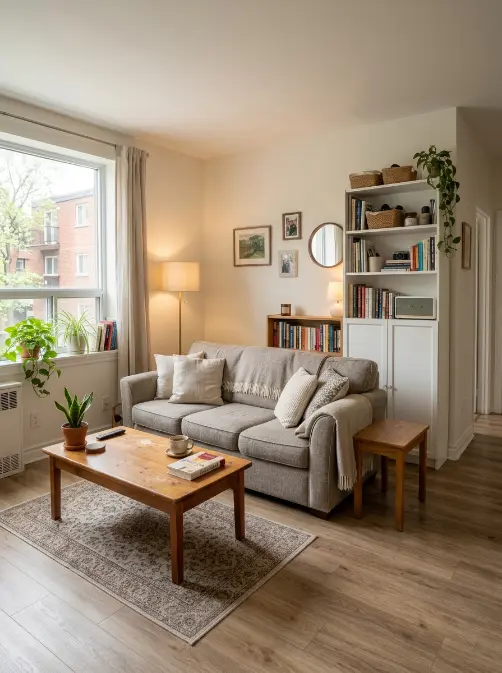
Decorating a small apartment on a budget is less about finding dozens of cheap things and more about being selective about what gets to occupy your limited space.
Before you buy another basket, side table, lamp, or piece of wall decor, look at what is making the apartment difficult to live in. Is there nowhere to put shoes? Is the sofa blocking the best walking route? Does everything end up on the kitchen counter? Is the lighting making the room feel flat?
Fix those problems first.
A simple order works surprisingly well: layout first, clutter second, storage third, lighting fourth, textiles fifth, and decorative extras last. That approach helps you make a small apartment feel more finished without filling it with inexpensive purchases you eventually have to store.
Start with the cheapest changes first
A budget makeover does not have to begin with shopping.
| Priority | What to tackle | Examples |
|---|---|---|
| First | Free changes | Rearrange furniture, declutter, relocate storage, repurpose what you own |
| Second | Small upgrades | Lighting, pillow covers, organizers, simple window treatments, artwork |
| Third | Functional purchases | Storage furniture, an appropriately sized rug, a desk or dining solution |
| Last | Pure decoration | Extra accessories, decorative baskets, tabletop objects and trend pieces |
That sequence also gives you time to discover what the apartment actually needs.
1. Measure the apartment before buying anything
The most expensive small-apartment mistake is often not buying something expensive. It is buying something inexpensive that does not fit.
Measure the wall where a sofa, desk, bookshelf, or dresser will go. Check the available depth as well as width, and make sure drawers, cabinet doors, room doors, and walking paths can still open comfortably.
Then keep those measurements on your phone while shopping secondhand or browsing sales.
This is especially useful with “space-saving” furniture. A narrow console may look tiny online but still project too far into an entryway. A storage ottoman is not helpful if it leaves no room to walk around the coffee table.
In a small home, fit is a feature.
2. Declutter before adding storage
It is tempting to respond to clutter by purchasing more containers. Sometimes that simply gives unwanted belongings nicer places to hide.
Start by sorting the problem area before choosing an organizer.
If your entryway is overflowing, decide what genuinely needs to live near the door. If kitchen cabinets are crowded, remove duplicates and rarely used items before adding shelf risers or bins. If clothes no longer fit comfortably in the closet, editing the wardrobe may create more usable space than adding another dresser.
The goal is not an empty apartment. It is to avoid paying for furniture whose only job is storing things you do not particularly need.
3. Rearrange the layout around how you actually move
Furniture does not have to stay where it landed on move-in day.
Look at the routes you use repeatedly: front door to kitchen, sofa to bathroom, bed to closet, desk to window. If those paths weave around furniture, the apartment can feel smaller than its actual footprint.
Try moving the largest pieces first. Shifting a sofa away from a doorway, rotating a desk, or moving a chair to another room can improve the space without costing anything.
Do not worry about making every wall perfectly symmetrical. In small apartments, a slightly unconventional arrangement that improves circulation is usually more useful than one that only looks balanced in a photo.
4. Give each zone one clear job
Studios and open-plan apartments often feel chaotic because multiple activities happen in the same visual field.
Instead of adding walls or bulky dividers, create lightweight zones.
A rug can identify a sitting area. A compact desk and lamp can mark a work area. A small table against a wall can become a dining zone. A narrow console can establish an entry area even when there is no actual foyer.
The goal is not to make each zone look like a separate room. It is simply to make the apartment easier to understand at a glance.
When a single piece of furniture belongs to two zones, that can be an advantage. A console behind a sofa, for example, might visually separate living and dining areas while providing useful surface space.
5. Make furniture earn its footprint
Multifunctional furniture is useful in a small apartment, but only when you will genuinely use both functions.
A storage ottoman can provide a place for blankets and occasional seating. A desk with drawers can eliminate the need for a separate filing unit. A drop-leaf table may work for meals without permanently occupying the center of a room.
But avoid buying complicated convertible furniture simply because it sounds clever.
Ask one question before bringing in a new piece:
What problem does this solve that my current furniture does not?
If the answer is vague, the piece probably does not deserve the floor space.
6. Use vertical storage before adding another cabinet
When floor area is limited, walls can take on more of the storage work.
A tall bookcase, wall-mounted shelf where permitted, over-door organizer, or taller cabinet can hold more without spreading storage across the room.
Keep frequently used items within easy reach and reserve higher areas for lighter or less frequently used belongings. Visually, repeating similar containers or leaving some breathing room between objects can keep vertical storage from becoming a wall of clutter.
There is an important safety exception to the “go tall” strategy: top-heavy furniture needs to be secured appropriately. The U.S. Consumer Product Safety Commission recommends anchoring furniture such as bookcases and dressers and following manufacturer instructions.
For renters, discuss necessary anchoring with the property owner or manager rather than treating “no holes” as more important than furniture safety.
7. Put storage where the clutter actually happens
Good storage is not simply storage that fits. It should fit the habit that created the mess.
If mail always lands on the dining table, create a small mail spot near the entrance. If blankets pile up beside the sofa, storage belongs in the living area rather than across the apartment. If toiletries crowd the sink, concentrate bathroom storage within reach of the vanity.
This principle keeps you from buying random organizers and hoping they solve the problem.
Think in terms of point-of-use storage: keep an item near the place where you use it and, just as importantly, near the place where you are likely to put it away.
8. Create an entryway even when you do not have one
A small apartment entrance can become cluttered quickly because shoes, bags, keys, jackets, and deliveries all compete for the same few feet.
You do not need a formal foyer to organize it.
Choose one narrow zone and give it a specific purpose. A small tray can contain keys. A compact shoe solution can keep footwear from spreading into the living room. Lease-approved hooks may handle lightweight everyday items. A mirror can make the area useful for a final check before leaving.
Keep this zone shallow. Oversized benches and deep storage cabinets can make a narrow entrance harder to navigate.
9. Improve the lighting before replacing the furniture
A room can feel unfinished even when the furniture is perfectly adequate if the lighting comes from one harsh ceiling fixture.
Layering light usually makes a small apartment feel more comfortable without requiring a renovation. A table lamp beside the sofa, a floor lamp in a dark corner, and task lighting at a desk can create distinct pools of light instead of illuminating the entire room in one flat layer.
This is particularly useful in a studio because lighting can reinforce the zones you created earlier.
Choose fixtures according to function first. A giant sculptural floor lamp may be attractive, but it is not a budget win if its base occupies the only useful corner.
10. Make the windows feel intentional
Window treatments can change the proportions of a room because they occupy a large vertical area.
Where your lease, existing hardware, and window design allow it, positioning curtains to emphasize height can draw the eye upward. Simple fabric also softens a room filled with hard surfaces such as cabinets, floors, windows, and furniture.
Avoid buying excessively bulky window treatments for a small room merely to create drama. You still need windows to function normally and should avoid blocking heating, cooling, or other building equipment.
If the apartment already has acceptable blinds or shades, decorative curtains are optional rather than a required purchase.
11. Choose one correctly scaled rug instead of several tiny ones
An undersized rug can make a seating arrangement look like several unrelated pieces floating around the room.
Before buying, use painter’s tape or another removable visual marker to map the proposed rug footprint on the floor. That makes it easier to judge whether the rug connects the sofa, chair, and coffee table or merely sits beneath the table like an island.
If a large rug is outside the budget, waiting can be smarter than buying a small placeholder you already know you will replace.
For studios, rugs can also help define living, sleeping, or dining zones without adding physical dividers.
12. Repeat a small color palette across the apartment
You do not have to paint everything white to make a small apartment work.
Instead, reduce unnecessary visual competition.
Choose a compact palette and repeat it across several objects. Warm wood could appear in the coffee table, picture frames, and kitchen accessories. A muted green might repeat in pillows, artwork, and a small textile. Black metal could connect lighting and furniture legs.
Repeating colors creates continuity, which is especially helpful when several functional zones are visible at once.
This does not mean every item has to match. The room usually feels more personal when materials and finishes vary slightly within a consistent overall direction.
13. Use textiles for affordable visual change
Replacing furniture every time your taste changes is rarely budget-friendly.
Textiles offer more flexibility.
A pillow cover can introduce color without replacing the sofa. Bedding can make a bedroom zone feel deliberate. A throw can soften a secondhand chair. Curtains can add texture across a large area of wall without permanently changing the room.
Try to use textiles to solve a visual problem rather than adding them automatically. If the sofa already has several pillows, adding five more inexpensive ones will not necessarily make the apartment feel cozier—it may simply reduce the usable seating area.
Comfort should still function as comfort.
14. Decorate with fewer, larger pieces
Small apartment does not have to mean tiny decor.
In fact, dozens of miniature frames, vases, trays, baskets, signs, and accessories can make a compact room visually noisy.
Try giving each visible surface a job. A console might hold a lamp, one meaningful object, and a practical tray. A wall could feature one larger piece of art instead of many small pieces purchased simply to fill space.
This approach is useful on a budget because it slows down decorative buying.
Leave some blank wall, counter, shelf, and tabletop space. Negative space is free, and it can make the things you genuinely like stand out more clearly.
15. Use mirrors strategically—not everywhere
Mirrors can be useful in compact apartments because they reflect existing light and views, but placement matters more than quantity.
Before hanging one, look at what it will reflect.
A mirror opposite a bright window may help distribute that brightness visually. A mirror reflecting a pile of laundry, crowded shelving, or an unattractive doorway simply duplicates the thing you would rather ignore.
Choose the mirror for the wall rather than buying one first and searching for somewhere to put it.
As with other wall-mounted items, use an installation method appropriate for the mirror, wall, manufacturer instructions, and rental rules.
16. Shop secondhand with dimensions, not hope
Secondhand furniture can be one of the most useful ways to stretch a decorating budget, but low price alone does not make something a good deal.
Keep a short measurement note on your phone containing the maximum width and depth for the pieces you actually need.
That changes the question from “Is this cheap?” to “Does this solve the problem?”
Prioritize solid function over the perfect finish. A table in the right dimensions can often be easier to style around than a beautiful table that blocks the walkway. Likewise, avoid buying furniture simply because you might find a use for it someday.
In a small apartment, storage space for “someday” purchases is especially expensive.
17. Decorate in waves instead of one shopping trip
The most budget-friendly small apartment may be the one you do not try to finish immediately.
After arranging your essential furniture, live with the space long enough to notice recurring frustrations. Maybe the problem is nowhere to put laundry. Maybe you need another lamp rather than another shelf. Maybe the kitchen works well and the living room deserves the next purchase instead.
Add one layer at a time:
function → storage → lighting → comfort → personality.
This gives each purchase a reason to exist.
It also creates a home that looks collected rather than assembled from a single shopping cart.
What should you avoid buying first?
The first purchases to question are decorative storage baskets without a specific purpose, matching furniture sets that may overwhelm a compact layout, small rugs bought only because they are cheaper, extra occasional tables, large pieces without confirmed measurements, and large amounts of tiny decor.
None of those items are inherently bad. The problem is buying them before you know what your apartment needs.
When money and space are both limited, every purchase has two costs: what you spend and how much room the item occupies.
How to make a small apartment feel cozy on a budget
Cozy does not require filling every corner.
Start with warmer, layered lighting. Add a few tactile textiles. Repeat two or three colors throughout the apartment. Display personal art, photographs, books, or objects you already value instead of trying to buy a ready-made personality.
Then edit.
If a surface becomes difficult to clean or a chair is covered in pillows before anyone can sit down, the styling has probably crossed from cozy into cluttered.
A comfortable small apartment usually has both texture and breathing room.
How to decorate a small apartment with almost no money
Begin with rearranging rather than purchasing.
Move art between rooms. Restyle shelves using books and objects you already own. Remove furniture that is blocking circulation. Repurpose a tray or bowl as a landing spot for everyday items. Rotate textiles between rooms. Put away excess decor and reintroduce only the pieces that improve the room.
Even moving a lamp from a well-lit area to a dark corner can change how the apartment feels.
The goal is not to make every change photogenic. It is to make the home easier and more pleasant to use.
What should you buy first for a small apartment?
After basic necessities, buy the item that solves the most persistent functional problem.
If you cannot comfortably eat or work, that may be a compact table. If clothing storage is failing, storage may come first. If the living room is functional but unpleasant at night, lighting may have the highest impact.
There is no universal first purchase because apartments—and the people living in them—work differently.
The best budget rule is simple: measure the problem before buying the solution.
Final takeaway
The best small apartment ideas on a budget are rarely about squeezing more objects into the room.
They are about making better use of what is already there.
Start by measuring and rearranging. Clear what you do not need. Put storage where clutter naturally collects. Let furniture serve more than one useful purpose. Improve lighting and textiles before replacing major pieces. Then add decor slowly enough that each object has a reason to stay.
A small apartment can feel polished, warm, and personal without looking crowded—and without being

1 Comment
[…] This guide is bedroom-only. It covers 12 bedroom upgrades in free-first order: 4 free, 5 low-cost, and 3 to save for last. For whole-apartment cozy, see cozy small apartment aesthetic. For whole-apartment budget, see small apartment ideas on a budget. […]